
Margin call vs stop out is easy to mix up. A margin call is a warning that your account is running short of margin. A stop out is the point where the broker starts closing your positions automatically. Both are read from one number, the margin level: equity divided by used margin, times 100. Brokers choose the two trigger levels, so the numbers in this post are illustrations, not anyone’s rules.
This post works two accounts, EUR/USD and gold, and shows the price move that reaches each trigger. It does not tell you how much leverage to use.
On this page 11 min read
- Key findings
- The four numbers and the margin level formula
- Margin call vs stop out
- Worked example 1: EUR/USD
- Worked example 2: gold
- Why leverage caps differ by country
- Negative balance protection
- Stop loss vs stop out
- What to take from it
- Frequently asked questions
- Method and data
- Sources and further reading
- Keep reading
Key findings
- Margin level = equity / used margin x 100. A higher number means more room. The broker’s margin call level and stop-out level are thresholds on that number.
- In our EUR/USD account (1 lot, 1:30, a 5,000 dollar balance), the margin level is 136.4% at the start. With illustrative thresholds of 100% and 50%, the price must fall 133.3 pips to reach the first and 316.7 pips to reach the second.
- The same 1 lot at 1:100 needs only 1,100 dollars of margin, so the triggers sit further away (390 and 445 pips), but the loss at a stop loss is identical.
- In these examples, a 20 pip stop loss is reached long before the stop out. That order depends on the position size relative to the account, and a price gap or a fast market can fill a stop at a worse price.
The four numbers and the margin level formula
Every trading platform shows some version of these numbers. The wording differs by platform, so check yours.
- Balance is the money in the account from deposits, withdrawals and closed trades. It does not include open trades.
- Equity is balance plus the profit or loss on open trades at the current price. It moves with every tick.
- Used margin is the deposit the broker holds against your open positions. It is not a fee and it is released when the position closes. For forex, the MetaTrader 5 help gives the formula as volume in lots times contract size divided by leverage, in the margin currency and converted to the account currency.
- Free margin is equity minus used margin: what the account has left to open new positions or absorb losses.
Margin level (%) = equity / used margin x 100
The MetaTrader 5 help page on forex margin does not define margin level, margin call or stop out. Those terms are broker-defined, so confirm the formula against your broker’s documentation.
With 5,000 of equity and 1,100 of used margin, the level is 5,000 / 1,100 x 100 = 454.5%. If the position loses 2,000 dollars, equity is 3,000 and the level is 272.7%. With no open positions, used margin is zero and the level is not defined, so most platforms show a blank. Free margin in the first case is 5,000 – 1,100 = 3,900.
Used margin = lots x contract size x price / leverage (for a pair quoted in dollars with a dollar account). Leverage 1:30 means margin of 1/30 of the position value, about 3.33%. Leverage 1:100 means 1%.
Margin call vs stop out
They are different events, and each broker sets its own levels.
| Term | What it usually means | Who decides the level |
|---|---|---|
| Margin call | A warning or notice that margin level has dropped to a threshold. The account may be restricted from opening new positions. | The broker, in its terms |
| Stop out (also called margin close-out) | The broker starts closing positions automatically until the level is back above the threshold, in an order set by the broker’s terms. | The broker, within any regulator rules |
Broker terms differ, and so can costs by broker model: check whether yours sends a margin call notice at all, what it calls each level, and in what order it closes positions.
Regulators in some countries fix the closing rule for retail clients. The FCA requires a close-out at 50% of the margin needed; ESMA’s 2018 measures, since replaced by national rules, used the same 50% figure. Details are in the leverage caps section below.
Worked example 1: EUR/USD
Assumptions, all invented for illustration: a 5,000 dollar account; EUR/USD at 1.1000; one lot is 100,000 euros; long; margin held fixed at its opening value (real platforms may recalculate); spread, swap and commission ignored; margin call at 100% and stop out at 50%.
Position value for 1 lot = 110,000 dollars. A pip is 0.0001, so the position gains or loses 10 dollars per pip per lot (1 dollar per pip for 0.1 lot).
| Position | Leverage | Used margin | Free margin | Margin level at start | Fall to reach 100% | Fall to reach 50% |
|---|---|---|---|---|---|---|
| 1 lot | 1:30 | 3,666.67 | 1,333.33 | 136.4% | 133.3 pips (price 1.0867) | 316.7 pips (price 1.0683) |
| 1 lot | 1:100 | 1,100.00 | 3,900.00 | 454.5% | 390.0 pips | 445.0 pips |
| 0.1 lot | 1:30 | 366.67 | 4,633.33 | 1,363.6% | 4,633 pips | 4,817 pips |
| 0.1 lot | 1:100 | 110.00 | 4,890.00 | 4,545.5% | 4,890 pips | 4,945 pips |
| 3 lots | 1:100 | 3,300.00 | 1,700.00 | 151.5% | 56.7 pips | 111.7 pips |
Illustrative account: 5,000 dollars, EUR/USD at 1.1000, long, margin held fixed, thresholds 100% and 50%. Figures computed by script.
First row: used margin = 110,000 / 30 = 3,666.67; free margin = 1,333.33; margin level = 5,000 / 3,666.67 x 100 = 136.4%. To reach 100%, equity must fall to the used margin, a loss of 1,333.33 dollars or 133.3 pips (price 1.0867). To reach 50%, equity must fall to 1,833.33, a loss of 3,166.67 dollars or 316.7 pips (price 1.0683), which is 63% of the balance.
Reading down the columns: leverage moves the triggers (1:100 holds 1,100 dollars of margin instead of 3,666.67), position size moves them more (0.1 lot needs thousands of pips), and a bigger position brings them closer. The 3 lot row needs 1:100, since 3 lots at 1:30 would need 11,000 dollars of margin. Each pip then moves the account by 30 dollars, so the stop out is 111.7 pips away.
A 20 pip stop costs 200 dollars on 1 lot (4.0% of 5,000) and 20 dollars on 0.1 lot (0.4%), whichever leverage the account has. Size the trade from the stop, not from the margin, as in our lesson on risk per trade and position sizing.
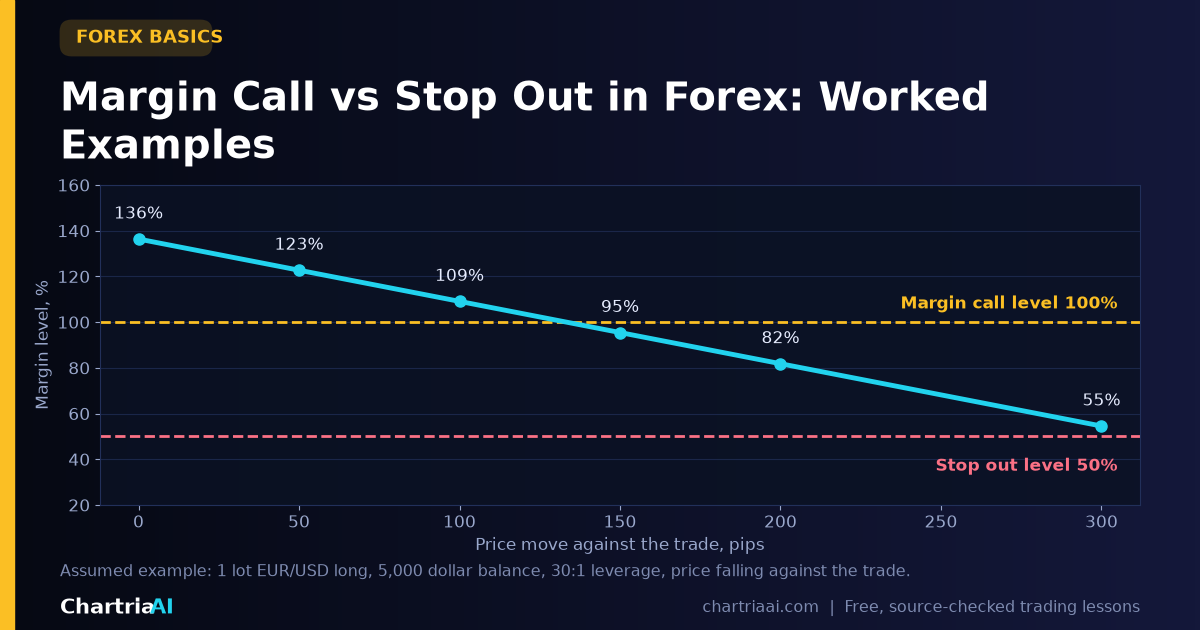
Margin level falls in a straight line as price moves against a long 1 lot, 1:30 position:
| Price move against you | Loss | Equity | Margin level |
|---|---|---|---|
| 0 pips | 0 | 5,000 | 136.4% |
| 100 pips | 1,000 | 4,000 | 109.1% |
| 200 pips | 2,000 | 3,000 | 81.8% |
| 300 pips | 3,000 | 2,000 | 54.5% |
Same account, used margin fixed at 3,666.67.
Worked example 2: gold
Gold is quoted in dollars per troy ounce, and brokers define the contract size in their specification. We assume 100 ounces per lot; read your own broker’s specification (more in gold lot size and stop distance). Other assumptions: a 5,000 dollar account; gold at 3,000 dollars per ounce (an invented price, not a forecast or quote); 0.2 lot = 20 ounces; long; margin held fixed; thresholds 100% and 50%; no spread or swap.
Position value = 0.2 x 100 x 3,000 = 60,000 dollars. A one dollar move in gold changes the account by 20 dollars.
| Leverage | Used margin | Free margin | Margin level at start | Fall to reach 100% | Fall to reach 50% |
|---|---|---|---|---|---|
| 1:20 | 3,000 | 2,000 | 166.7% | 100 dollars (3.3%), price 2,900 | 175 dollars (5.8%), price 2,825 |
| 1:100 | 600 | 4,400 | 833.3% | 220 dollars (7.3%), price 2,780 | 235 dollars (7.8%), price 2,765 |
Illustrative figures computed by script: 0.2 lot, 100 oz per lot assumed, gold at 3,000, balance 5,000.
At 1:20, 60% of the account is margin from the first moment, and a 175 dollar fall (5.8%) reaches the stop out. We make no claim about how often gold moves that far; see our gold trading tools for gold’s moves in our data.
A 15 dollar stop on this position loses 300 dollars, 6% of the account. Work out the loss at the stop first, then check the margin. A position can have plenty of free margin and still risk more per trade than intended.
Why leverage caps differ by country
Maximum leverage is set by the regulator that covers the broker entity you trade with, not by the platform.
European Union (ESMA). ESMA’s 2018 measures for retail CFD clients included 30:1 on major currency pairs and a close-out at 50% of the minimum required margin, but they were temporary. Its statement of 31 July 2019 says they expired at the end of that day because most national authorities had adopted permanent national measures at least as stringent. The rules in an EU country today are that country’s national measures, so check the national regulator or the broker’s terms.
United Kingdom (FCA). The FCA’s release of 1 July 2019 says firms must limit leverage to between 30:1 and 2:1, close out a customer’s position “when their funds fall to 50% of the margin needed to maintain their open positions” on their CFD account, and provide negative balance protection, which caps a retail client’s losses at the total funds in their CFD account. The rules applied from 1 August 2019 for CFDs and 1 September 2019 for CFD-like options.
Australia (ASIC). ASIC’s media release 22-082MR says its CFD product intervention order, in effect since 29 March 2021, was extended for five years to 23 May 2027. Leverage limits range from 30:1 to 2:1, and the order standardises margin close-out rules and includes negative balance protection for retail clients.
United States (NFA). The NFA forex regulatory guide (September 2022 revisions) lists a security deposit of 2% of notional value for major currency groups and 5% for other currencies, about 50:1 and 20:1. The guide says these minimums apply unless otherwise noted by NFA’s Executive Committee, and that a pair with mixed requirements takes the higher one.
Professional client status and a broker’s choice of entity can change which rules apply. These figures are about regulation, not what suits you.
Negative balance protection
Negative balance protection, where it applies, limits a retail client’s losses to the money in the account, so the account is not left owing the broker. The FCA release describes it for UK CFD accounts, and ASIC’s order lists it too. It is not universal: it depends on the broker entity and the country.
For US off-exchange forex, the NFA guide says forex dealer members with trading platforms must set automatic liquidation levels “high enough so that positions will be closed out at prices that will prevent the account from going into a deficit position under all but the most extraordinary market conditions.” A gap in price can still carry the account past the trigger before the order fills. Check your broker’s terms for what happens to a negative balance.
Stop loss vs stop out
A stop loss is set by you, per trade, at a price you choose. A stop out is set by the broker, per account, at a margin level. In example 1, a 20 pip stop on 1 lot at 1:30 is 20 pips from entry; the stop out is 316.7 pips away. The stop out matters when there is no stop loss, when several positions together use much of the margin, when the market gaps past a stop, or when the position is large relative to the account, like the 3 lot row.
Free margin is shared across all open positions, so a new trade moves the account closer to a margin call without any price move (see correlation and diversification). For how to set a stop, see where to place a stop loss.
What to take from it
- Learn your broker’s two levels from its own terms. If you cannot find them, ask in writing.
- Compute the loss at your stop before you look at margin. Margin tells you what is held, not what you can lose.
- Do the arithmetic for your own account with the margin calculator, and size trades from the stop with the position size calculator.
Frequently asked questions
What is the difference between a margin call and a stop out?
A margin call is a warning that margin level has fallen to a threshold set by the broker. A stop out is the later step where positions are closed automatically. Each broker sets both levels in its terms, and some may not send a warning at all.
What margin level is a stop out?
It depends on the broker and on any regulator rule. The FCA rules, and ESMA’s 2018 measures (since replaced by national measures), describe a close-out when funds fall to 50% of the required margin for retail CFD clients. Other brokers and regions use other levels, so read your account terms.
Can I lose more than my deposit?
It depends on the entity and the country. Some regulators require negative balance protection for retail clients, as in the UK and Australia pages cited here. Elsewhere it may not apply, and a gap can pass the stop out level before positions close. Read the terms.
Does higher leverage make a margin call more likely?
Higher leverage lowers the margin needed for a given position, which moves the triggers further away for that position. But it also allows a larger position on the same balance, which brings them closer. The result depends on the position you actually open.
Why was my trade closed when my stop loss was not hit?
Possible reasons include a stop out on margin level, a broker rule on closing, or a gap or fast market. Check the account history and the broker’s terms, and check whether yours sends a warning. A statement from the broker is the way to be sure.
Method and data
This post uses no market data. Every figure is computed by a script from the formulas in the text; the price move to a trigger is (balance – used margin x trigger level / 100) / (lots x contract size). Accounts, prices and thresholds are invented, margin is held fixed, and spread, commission, swap and conversion are ignored, so real figures will differ. Regulator facts were read from the pages below on 22 November 2026, and rules can change.
Educational content only, not financial advice. Trading involves substantial risk of loss. Read the full risk disclaimer.
Sources and further reading
- ESMA, “ESMA agrees to prohibit binary options and restrict CFDs to protect retail investors”, 27 March 2018: https://www.esma.europa.eu/press-news/esma-news/esma-agrees-prohibit-binary-options-and-restrict-cfds-protect-retail-investors
- ESMA, “ESMA adopts final product intervention measures on CFDs and binary options”, 1 June 2018: https://www.esma.europa.eu/press-news/esma-news/esma-adopts-final-product-intervention-measures-cfds-and-binary-options
- ESMA, statement ceasing renewal of the product intervention measures, 31 July 2019: https://www.esma.europa.eu/press-news/esma-news/esma-ceases-renewal-product-intervention-measures-relating-contracts
- FCA, “FCA confirms permanent restrictions on the sale of CFDs and CFD options to retail consumers”, 1 July 2019: https://www.fca.org.uk/news/press-releases/fca-confirms-permanent-restrictions-sale-cfds-and-cfd-options-retail-consumers
- ASIC, media release 22-082MR, CFD product intervention order extended for five years: https://asic.gov.au/about-asic/news-centre/find-a-media-release/2022-releases/22-082mr-asic-s-cfd-product-intervention-order-extended-for-five-years/
- NFA, Forex Transactions: Regulatory Guide (September 2022 revisions): https://www.nfa.futures.org/members/member-resources/files/forex-regulatory-guide.html
- MetaTrader 5 Help, margin calculation for forex: https://www.metatrader5.com/en/terminal/help/trading_advanced/margin_forex
Keep reading
- Margin and leverage calculator
- Position size calculator
- Risk per trade and position sizing
- Where to place a stop loss
- How to check a forex broker before you deposit
Last reviewed 22 November 2026. Published by ChartriaAI. Questions or corrections: use our contact page, and see how we check our work.