
Market maker vs ECN is a common question about forex brokers, and the labels sound more precise than they are. Each one describes a business model, and firms use the words loosely. This post does not name or rank any firm. It covers what the labels usually claim, what can be checked, the cost arithmetic for two account styles, and a 20-fill log you can run on your own account.
Short answer: neither label tells you which account is cheaper or fills better; cost per lot and your own fills do.
On this page 10 min read
- Key findings
- The terms: dealing desk, STP, ECN
- Who is on the other side, in neutral words
- Questions worth asking in writing
- Cost arithmetic: spread-only vs raw spread plus commission
- Slippage, requotes, rejections and last look
- Worked example: logging 20 fills
- What you can and cannot conclude
- What to take from it
- Frequently asked questions
- Method and data
- Sources and further reading
- Keep reading
Key findings
- Dealing desk, STP and ECN describe the order-handling model a firm states. They do not tell you your cost or your fill quality. The execution policy and account terms do.
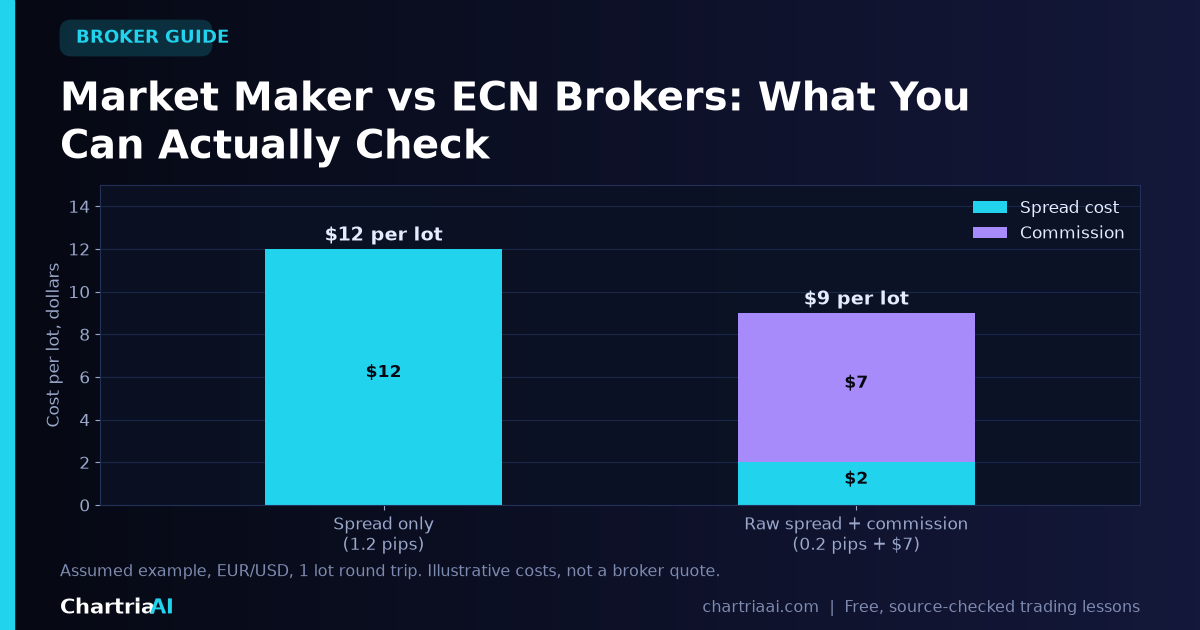
- With the assumed values in this post, a 1.2 pip spread-only account costs 12.00 dollars per lot round-turn, and a 0.2 pip raw spread plus a 7.00 dollar commission costs 9.00 dollars. The raw account is cheaper at these two spreads only while its commission stays below 10.00 dollars.
- Our invented 20-order log shows a mean slippage (adverse counted as positive) of 0.24 pips on the 18 fills, with an approximate 95% range of 0.01 to 0.47. Twenty fills cannot rank a broker.
The terms: dealing desk, STP, ECN
These are our descriptions of common usage, not regulator definitions.
- Dealing desk or market maker: the firm quotes prices and takes the other side of client trades, sometimes passing risk on to others and sometimes keeping it.
- STP (straight-through processing): orders are described as passed on to one or more liquidity providers without manual handling.
- ECN (electronic communication network): the label usually suggests that orders meet other participants’ orders in a shared pool, often with a narrow raw spread and a separate commission.
None of the documents we read defines these three terms, so the same word can describe different setups at different firms, and one firm may handle some orders itself and pass others on. Read each firm’s own description of its model. The useful question is not “which label?” but “what does the written policy say, and what do my own fills show?”
MetaTrader 5’s help describes four execution modes and says the brokerage company defines the mode for each security. Those describe how an order is priced on the platform, which is not the same thing as a business model.
Who is on the other side, in neutral words
When a firm is the counterparty to your trade, its interests and yours are not identical. That says nothing about any firm’s conduct; what matters is that it is described in writing.
Regulators describe the expected standard in terms of policies. The ESMA final report on order execution policies (10 April 2025) sets out draft technical standards and was sent to the European Commission. It restates the MiFID II Article 27 rule that investment firms take “all sufficient steps to obtain, when executing orders, the best possible result” for clients, taking into account price, costs, speed, likelihood of execution and settlement, among other factors. For retail clients the best possible result is judged in terms of the “total consideration”, meaning the price plus the costs of execution. In its background section the report also says retail clients “legitimately rely on the firm to protect their interests” in relation to the pricing and other parameters of the transaction, and that professional clients may not always rely on the firm in the same way.
That is one framework for one region. Rules differ by country, some products fall outside them, and the rules that apply depend on where the entity holding your account is licensed. Check which entity holds your account, which regulator supervises it, and what its documents say, using our guide on how to check a forex broker before you deposit. Ask for the execution policy and read it. For margin rules once a position is open, see margin call vs stop out.
Questions worth asking in writing
Ask the firm in writing whether it takes the other side of client orders, sends them to liquidity providers, or both; which MetaTrader execution mode your symbol uses; how commission is quoted (per side or round-turn); whether last look is used and disclosed; and the rules on requotes and rejections near news. Keep the replies.
Cost arithmetic: spread-only vs raw spread plus commission
Two account styles are common: a spread-only account (wider spread, no commission) and a raw spread account (narrow spread plus a commission per lot). Which costs less is arithmetic.
All values are assumed, not any firm’s terms. On EUR/USD one pip is 0.0001, or 10 dollars per pip per standard lot. The spread is paid once per round-turn, and commission is per lot round-turn.
Cost per lot round-turn = spread in pips x 10 + commission
| Account style | Spread (pips) | Commission per lot round-turn | Cost per lot round-turn |
|---|---|---|---|
| Spread-only | 1.2 | 0.00 | 12.00 dollars |
| Raw spread | 0.2 | 7.00 | 9.00 dollars |
Assumed values, computed by script.
The break-even commission is (1.2 – 0.2) x 10 = 10.00 dollars. Below that the raw account is cheaper at these two spreads, above it the spread-only account is. A 7.00 dollar commission equals 0.7 pips, so the raw account’s all-in cost is 0.9 pips against 1.2 pips. Over 100 round-turns of 0.1 lot that is 90.00 against 120.00 dollars.
The comparison moves with the spread. At the same 7.00 commission, a raw spread of 0.5 pips costs 12.00 per lot, the same as the spread-only account at 1.2 pips, and a raw spread of 1.0 pips costs 17.00; a spread-only account at 1.0, 1.5 and 2.0 pips costs 10.00, 15.00 and 20.00. Your own average spread at your trading times decides it.
Against a 10 pip stop distance, the assumed costs are 12% and 9%. The lesson on order types, spreads and costs shows how to add spread, commission and swap into one number, and the profit and loss calculator and pip value calculator do the dollar arithmetic.
Slippage, requotes, rejections and last look
Slippage is the difference between the price you asked for and the price you got: adverse, zero or favourable. A requote is a new price offered after your order is declined at the original one. A rejection is an order that does not fill.
MetaTrader 5’s help describes Instant execution (a requote follows if the broker does not accept the prices sent), Request execution (the price is requested first and the fill happens at the quoted price), Market execution (the broker decides the price, and sending the order means “advance consent to its execution at this price”) and Exchange execution (orders go to an external trading system).
Last look is a practice in electronic trading where the party receiving a trade request has a final chance to accept or reject it against its quoted price. The FX Global Code (Principle 17) says market participants employing last look should be transparent about it and give appropriate disclosures. It says disclosure should cover whether and how price changes in either direction affect the decision to accept or reject, the typical time taken, and the purpose of using last look. It also says last look should be a risk control that checks validity or price, and should not be used for information gathering with no intention to accept the request. The FX Global Code is a voluntary set of principles for the wholesale FX market, not a law; a retail broker may or may not have signed a statement of commitment to it. Treat it as a list of questions, not a statement about any firm.
Worked example: logging 20 fills
You can measure your own fills. For each market order, log the time, side, the price shown when you clicked (requested), the fill price, and whether it filled. Adverse slippage in pips is fill minus request for a buy and request minus fill for a sell. The trading journal can hold the log (see also keeping a trading journal), or use a spreadsheet.
The 20-order log is invented for illustration, not from any account or firm. The table shows only the five orders sent within a minute of a scheduled release (“news”; see the economic calendar); the other 15 quiet orders are not shown here. Times are UTC.
| # | Time | Context | Side | Requested | Filled | Adverse slippage (pips) |
|---|---|---|---|---|---|---|
| 8 | 12:30 | news | buy | 1.10055 | 1.10071 | 1.6 |
| 9 | 12:30 | news | sell | 1.10040 | 1.10027 | 1.3 |
| 10 | 12:31 | news | buy | 1.10090 | rejected | n/a |
| 16 | 18:00 | news | buy | 1.09970 | 1.09979 | 0.9 |
| 17 | 18:01 | news | sell | 1.09960 | rejected | n/a |
Invented illustration, 5 of 20 market orders on EUR/USD. Slippage computed by script.
The summary, computed by script:
| Measure | Value |
|---|---|
| Orders sent / filled / rejected | 20 / 18 / 2 |
| Adverse / zero / favourable fills | 9 / 7 / 2 |
| Mean slippage, adverse counted as positive (18 fills) | 0.24 pips |
| Largest adverse slippage | 1.6 pips |
| Mean, 15 quiet orders | 0.03 pips |
| Mean, 3 filled news orders (5 sent) | 1.27 pips |
At 10 dollars per pip per lot, 0.24 pips is about 2.39 dollars per lot, the same order of size as the commission differences above. In this invented log, most slippage and both rejections fall on the news orders, which is why you record the context.
What you can and cannot conclude
Twenty orders are a small sample. Standard error is the spread of the fills divided by the square root of the count: here the standard deviation is 0.49 pips and the standard error 0.12, so an approximate 95% range for the mean is 0.01 to 0.47 pips. The range is wide relative to the mean and assumes independent fills, which news orders are not.
Rejections are harder still. If the true rejection rate were 5%, the chance of seeing zero rejections in 20 orders would be 35.8%. So 20 fills can neither show that a firm has no rejections nor show that it has many.
A log can show your own costs on your own account at your own times. It cannot rank firms, and nothing here is a verdict on any firm.
What to take from it
- Treat “market maker”, “STP” and “ECN” as claims to read against the written policy, not as measures of quality.
- Compare accounts on cost per lot at your own spreads and hours, not on the headline spread.
- Log your own fills with context. Twenty fills are a start, not a ranking.
Frequently asked questions
Is an ECN account always cheaper than a market maker account?
No. Cost depends on the real spread and commission at the time you trade. At the assumed values here, the raw account costs 9.00 dollars per lot against 12.00, but a commission above 10.00 dollars reverses that. Compare the numbers on your own account.
What is the difference between STP and ECN?
We found no regulator definition of either label in the documents we read, so the same word can mean different setups at different firms. In common use STP means orders are passed on to liquidity providers, and ECN suggests a shared pool of orders with a commission. Read the written execution policy instead of relying on the label.
Does a market maker trade against its clients?
Some firms take the other side of client trades, and their documents should say so. That describes a business model, not misconduct. Ask for the execution and conflicts policy, read it, and compare it with your own logged fills.
What is last look in forex?
Last look is a practice in which the receiver of a trade request has a final chance to accept or reject it against the quoted price. The FX Global Code says users should be transparent about it, disclose how it works, and use it only as a validity and price check (the Code is voluntary and written for the wholesale market).
How many trades do I need to judge execution quality?
There is no fixed number. Twenty fills cannot separate a 2%, 5% or 10% rejection rate (at a true 5% rate, zero rejections in 20 orders has a 35.8% chance), and slippage varies with time of day and news. A log over weeks, covering quiet and news periods, gives more information, but it still describes one account, not a whole firm.
Method and data
This post uses no market data. We computed every figure with our own script, and an automated test of ours checks each number. The full 20-order log is not shown here. The account terms, spreads, commissions and the 20-order log are invented illustrations and are not any firm’s terms or any real trades. Swap, currency conversion and spread widening are ignored. Slippage is adverse positive, and the approximate 95% range is the mean plus or minus 1.96 standard errors. Rejection odds use a binomial model with independent orders. The ESMA report is dated 10 April 2025 and we state nothing about later steps. Regulator and platform statements were read on 22 November 2026 and can change.
Educational content only, not financial advice. Trading involves substantial risk of loss. Read the full risk disclaimer.
Sources and further reading
- ESMA, Final Report: Technical Standards specifying the criteria for establishing and assessing the effectiveness of investment firms’ order execution policies, 10 April 2025: https://www.esma.europa.eu/sites/default/files/2025-04/ESMA35-335435667-6253_Final_Report_-_MiFID_II_RTS_on_order_execution_policies.pdf
- Global Foreign Exchange Committee, FX Global Code, Principle 17 (last look): https://www.globalfxc.org/uploads/fx_global.pdf
- MetaTrader 5 Android help, Types of Execution: https://www.metatrader5.com/en/mobile-trading/android/help/trade/general_concept/execution_types
Keep reading
- How to check a forex broker before you deposit
- Order types, spreads and costs
- Profit and loss calculator
- Trading journal
- Margin call vs stop out in forex
Last reviewed 22 November 2026. Published by ChartriaAI. Questions or corrections: use our contact page, and see how we check our work.