
Short answer: there is no single required win rate. It depends on your reward to risk (the size of your average win compared with your average loss), your risk per trade, the profit target, the loss limits, how many trades you can take in the time allowed, and your costs. Here is one worked example.
| Average win (loss = 1R) | Break-even win rate after costs (arithmetic) | Win rate at which about half of simulated attempts passed |
|---|---|---|
| 1R | 52.5% | about 56% (at 2% risk) |
| 1.5R | 42% | about 46% (at 1.5% risk) |
| 2R | 35% | about 39% (at 1.5% risk) |
| 3R | 26.25% | about 30% (at 1.25% risk) |
Example rules (illustrative, not any firm’s): an 8% profit target, then a 5% target in a second phase; a 5% daily loss limit; a 10% maximum loss from the starting balance; 30 trading days per phase; 2 trades a day; R is the amount risked, set as a percentage of the starting balance; a cost of 0.05R on every trade. “Pass” here means reaching both targets without hitting either loss limit or running out of days. It does not mean receiving a payout.
Break-even is (1 + 0.05) / (average win in R + 1): at that win rate the average trade makes nothing after costs. The last column is a simulation: the lowest win rate, in 1-point steps, at which at least half of 1,200 simulated attempts passed, using the best of six risk sizes from 0.5% to 2% (shown in brackets). It assumes independent trades with a fixed win rate and fixed win and loss sizes. Passing about half the time also means failing about half the time. This is arithmetic and simulation, not a forecast or advice.
To try other rules, enter your own win rate in the prop firm challenge calculator.
Every prop firm challenge asks the same question: can you reach a profit target without breaking a loss limit? The useful follow-up is a number: how good does your trading need to be for that to be likely? We simulated thousands of attempts to find out, then looked at four kinds of trader and what each would pay in fees. The model is the one behind our prop firm challenge calculator, and you can re-run every figure.
On this page 8 min read
Key findings
- To pass half of two-step challenges you need a positive expectancy of roughly +0.07R to +0.15R per trade after costs, depending on how big your winners are.
- With 1R winners that means winning about 56% of trades. With 3R winners, about 30% is enough.
- Overtrading is the fastest way to fail: at 6 trades a day and 1.5% risk, 68% of attempts broke the daily loss limit.
- A trader with a solid edge passes in a median of 18 days. A trader with a thin edge needs about 25.
- For a trader with a thin edge, getting funded costs about $1,006 in fees on a $500 challenge (attempts capped at three), against about $552 for a solid edge.
The rules we simulated
These are illustrative values, not any firm’s current terms: an 8% target in phase 1 and 5% in phase 2, a 5% daily loss limit, a 10% static maximum loss, 30 days per phase, and a $500 fee. Trades win or lose a fixed multiple of the amount risked (R), with a cost of 0.05R per trade, and the amount risked is a percentage of the starting balance. Each result is 4,000 simulated attempts with a fixed random seed. Our lesson Prop firm challenge math explains the model and checks it against an exact result.
How good do you need to be?
For each average winner size, we searched win rates from 20% upward and, at each, tried six risk sizes from 0.5% to 2%. The table shows the first win rate at which the best risk size passed at least half of the attempts:
| Average winner | Win rate needed (to pass about half) | Expectancy at that win rate | Risk size that worked best |
|---|---|---|---|
| 1.0R | about 56% | +0.07R | 2.0% |
| 1.5R | about 46% | +0.10R | 1.5% |
| 2.0R | about 39% | +0.12R | 1.5% |
| 3.0R | about 30% | +0.15R | 1.25% |
Search steps are 1 percentage point with 1,200 attempts per test, so read the win rates as ‘about’. Expectancy = win rate x winner size – (1 – win rate) x 1R – 0.05R cost.
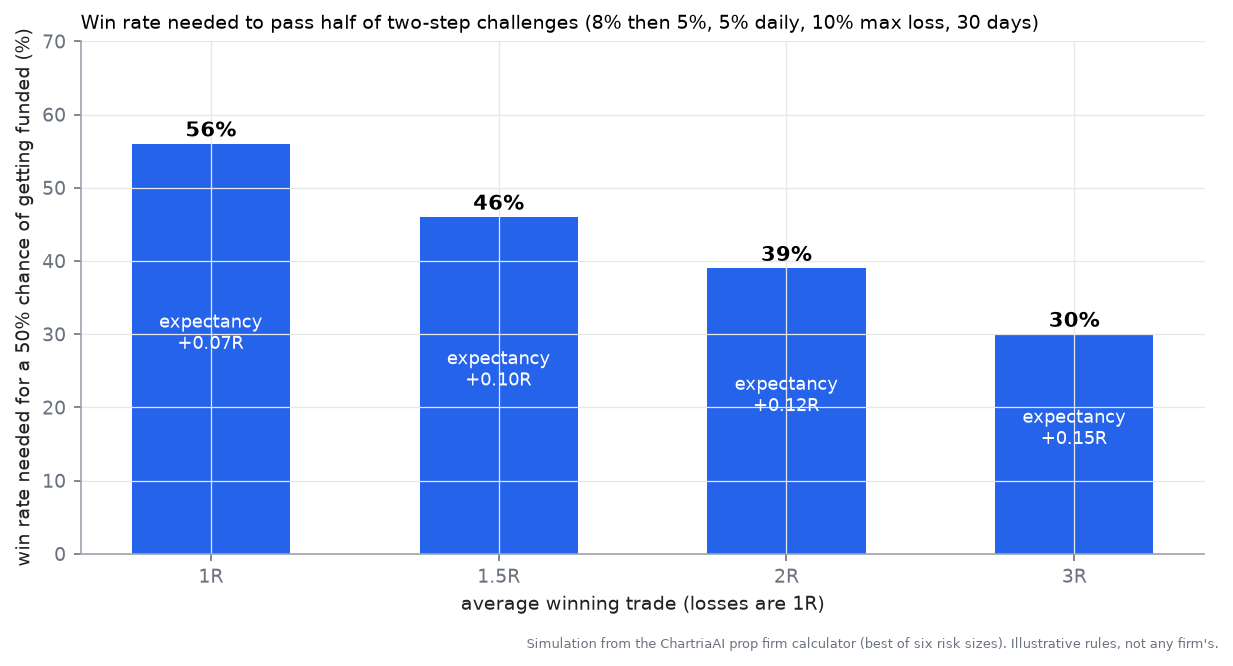
The expectancy needed barely changes with the shape of your trading: roughly +0.07R when winners are 1R and +0.15R when they are 3R. A trader who wins 30% of the time with 3R winners needs the same kind of edge as one who wins 56% of the time with 1R winners, and both edges have to be real. It is worth noticing that a 30% win rate means losing 70% of the time, which tests discipline as much as skill.
Four traders, one challenge
Take four hypothetical traders and run them through the same rules. “Cap 3” means a trader who stops after three attempts.
| Trader | Funded in one attempt | Failed by daily / max loss / time | Median days to pass | Funded within 3 attempts | Expected spend, up to 3 attempts |
|---|---|---|---|---|---|
| A: solid edge (55% wins, 1.5R, 1% risk, 2 trades a day) | 90% | 0% / 2% / 8% | 18 days | 100% | $552 |
| B: thin edge (45% wins, 1.5R, 1% risk, 2 trades a day) | 38% | 0% / 23% / 39% | 25 days | 76% | $1,006 |
| C: overtrading (45% wins, 1.5R, 1.5% risk, 6 trades a day) | 29% | 68% / 3% / 0% | 5 days | 65% | $1,104 |
| D: no edge (40% wins, 1.5R, no costs, 1% risk, 2 trades a day) | 21% | 0% / 38% / 41% | 25 days | 51% | $1,208 |
Trader D has a zero expectancy before costs (40% wins at 1.5R, no costs); the others have the 0.05R cost. Failure shares are among all attempts, both phases combined.
- A (solid edge): passes 90% of the time, in about 18 days. The fee is nearly the whole cost.
- B (thin edge): passes 38% of the time. 39% of attempts run out of time and 23% break the maximum loss. A thin edge needs many trades, and the 30-day clock allows few.
- C (overtrading): the same thin edge, but six trades a day at 1.5% risk. Passing is faster (median 5 days) but 68% of attempts break the 5% daily limit. Four losses in a row cost about 6.3% with costs.
- D (no edge): passes 21% of attempts by luck inside the limits. Over a long run that luck is paid for in fees.
If 100 traders each bought up to three attempts
| Trader type | Funded out of 100 | Total fees paid (3-attempt cap) | Fees per funded trader (3-attempt cap) |
|---|---|---|---|
| A | 100 | $55,231 | $553 |
| B | 76 | $100,585 | $1,327 |
| C | 65 | $110,403 | $1,709 |
| D | 51 | $120,770 | $2,387 |
Each trader stops when funded or after three attempts, paying $500 each time. Assumes independent attempts with the same pass rate. The expected fees figure in the prop firm challenge calculator is a different measure: it assumes unlimited retries, so it equals the fee divided by the pass rate.
The fee per funded trader is the number to watch. For the solid-edge trader it is about the fee itself. For the thin-edge trader it is about double, and for the no-edge trader it is more than that, while far fewer end up funded. This ignores the value of the funded account, which depends on profit splits, scaling and payout rules that are not modelled.
How long does passing take?
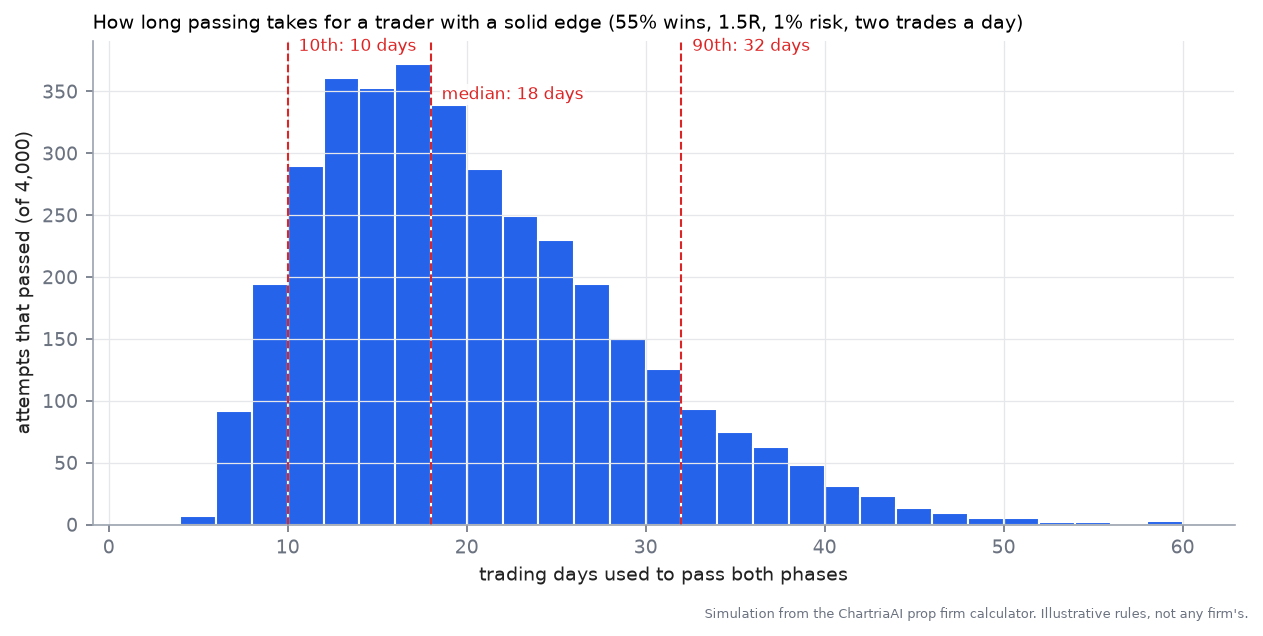
For the solid-edge trader, the 10th percentile of passes took 10 days, the median 18 and the 90th percentile 32, across both phases combined. Even a good trader may need a month or more in a minority of cases, which is why time limits matter.
Frequently asked questions
What win rate do I need to pass a prop firm challenge?
It depends on your winner size. Under our illustrative rules, a trader with 1R winners needed about 56% to pass half of attempts, with 1.5R winners about 46%, with 2R about 39% and with 3R about 30%. Each equals a positive expectancy of roughly 0.07R to 0.15R after costs.
Is it better to risk more to finish faster?
Only up to a point. In our tests the pass rate flattened between 1% and 1.5% risk and then fell as the maximum loss was hit more often. Trading more often at a high risk also made the daily loss limit the main reason for failure (68% of attempts for trader C).
How many attempts should I plan to pay for?
Plan on the fee divided by your pass rate. A trader passing one attempt in three should expect about three fees. If you cannot estimate your pass rate, that is a sign to measure your results on a demo first.
Do these figures apply to every firm?
No. The rule values are illustrative. Firms differ in targets, loss limits, trailing rules, time limits, minimum trading days and consistency conditions, and these change over time. Put your firm’s actual rules into the calculator and check its current terms.
Method and data
| Source | Simulation, not market data: the ChartriaAI prop firm simulator, run from the website’s own JavaScript |
|---|---|
| Runs | 4,000 simulated attempts per case with a fixed random seed; win-rate search in 1-point steps with 1,200 attempts per test |
| Rules assumed | 8% and 5% targets, 5% daily loss, 10% static maximum loss, 30 days per phase, $500 fee (illustrative, not any firm’s current terms) |
| Trade model | Independent trades with the same win probability and size; risk is a percentage of the starting balance; cost of 0.05R per trade |
| Not modelled | Slippage, minimum trading days, consistency rules, profit split, payouts |
| Check | Exact gambler’s-ruin comparison: 55.58% simulated against 55.56% exact |
All figures come from the ChartriaAI prop firm simulator, run in V8 from the website’s own JavaScript with a fixed seed, so the post and the calculator agree. It assumes independent trades with the same win probability and size, a static maximum loss, a daily loss measured from the equity at the start of each day, and no minimum trading days, consistency rules, slippage, profit split or payouts. A check against the exact gambler’s-ruin result (a fair coin, +8 target, -10 limit) gave 55.58% against the exact 55.56%.
Go further
- Prop firm challenge calculator – enter your own rules and results
- Prop firm challenge math – the model, the exact check and more tables
- Prop firm rules and risk – how daily and maximum loss limits are calculated
Last updated 19 October 2026. Published by ChartriaAI. Questions or corrections: use the Report an error button at the bottom of any lesson, and see how we check our work.