
What you will learn
- What a proprietary (“prop”) trading evaluation is and which rules it usually has.
- How a daily loss limit and a maximum loss limit are calculated, using the rules one large firm publishes as a worked example.
- Why these limits are measured on equity, and what that means for open trades, swaps and gaps.
- How to choose a risk per trade so that a normal bad day stays far from the limit.
The idea in plain words
A prop firm evaluation (also called a “challenge”) is a paid test. You trade a simulated account under rules, and if you reach a profit target without breaking the loss rules, the firm may offer you a funded account in which you share the profits. The details differ from firm to firm and change over time. This lesson uses the rules that FTMO published on its Trading Objectives page, read on 17 October 2026, as an example of how such rules are written. It is not a recommendation of any firm, and a firm’s current rules always override this page.
The essential point is that the rules are not about being a good trader on average. They are hard limits on how far your equity may fall, checked continuously. A trader with a profitable method can still fail by taking one oversized day.
Throughout this lesson, “equity” means balance plus the floating profit or loss of open positions, minus swaps and commissions. FTMO defines it in these terms.
How it works
The four common rules
- Profit target. A minimum profit above the starting capital, for example 10% in a first phase and 5% in a second phase of a two-step evaluation.
- Maximum daily loss. A floor under today’s equity, recalculated every day.
- Maximum loss. An overall floor under equity, either fixed or trailing.
- Minimum trading days. A minimum count of days on which you opened at least one position (4 days in FTMO’s two-step programme).
Some programmes add other conditions, such as consistency rules that limit how much of your profit may come from one day. FTMO’s page shows that its rules differ between its 1-Step, 2-Step and Instant programmes, and that a consistency rule replaces an earlier best-day rule for accounts ordered on or after 12 October 2026. So rules change even within a single firm.
How the daily loss limit is calculated
In FTMO’s description, the daily limit is recalculated at 00:00 Central European (Summer) Time. It is the account balance recorded at that moment, minus the maximum daily loss amount, which is a percentage of the initial capital (5% in the 2-Step programme, 3% in the 1-Step programme). Equity must not fall below the result.
Example from the firm’s page, 2-Step, $100,000 account:
– Day 1 limit: $100,000 − $5,000 = $95,000.
– Midnight balance $102,000 gives a Day 2 limit of $102,000 − $5,000 = $97,000.
– Midnight balance $101,000 gives a Day 3 limit of $101,000 − $5,000 = $96,000.
The percentage is of the initial capital, not of the current balance, and the reference is the midnight balance. This matters: the limit moves with your results, and the clock that resets it is the firm’s clock, not yours.
How the maximum loss is calculated
Here the programmes differ. In FTMO’s 2-Step programme the maximum loss is static: initial capital minus 10%, so $90,000 for a $100,000 account, forever. In its 1-Step programme the maximum loss is an end-of-day trailing limit: the highest midnight balance so far (or the initial capital if higher) minus 10% of the initial capital, and the limit can rise but never fall. The firm’s example has a $104,000 midnight balance on Day 1 and a Day 2 limit of $94,000, which stays at $94,000 on Day 3 even though the Day 3 balance is lower. The page also describes a further programme with an intraday trailing limit that rises as soon as a trade closes at a new balance high.
A trailing limit is more demanding than a static one, because profits raise the floor and leave less room for giving back gains.
Why equity, not balance
The limit applies to equity, so an open position that is losing counts before you close it. Two things follow:
– A trade that is open when the limit is touched breaks the rule even if you would have recovered later.
– Swaps and commissions reduce equity too.
Gaps and slippage
A stop-loss does not guarantee the exit price. Over a weekend, prices can jump past a stop. On our demo feed, EUR/USD closed on Friday 6 March 2026 at 1.16126 and opened on Monday 9 March at 1.15442, a gap of 68.4 pips. A long position opened near the Friday close, with a stop-loss 30 pips below the entry, would have exited at the open, about 68 pips from the Friday close, not at 30 pips. The loss would have been more than twice the planned amount, and a prop firm’s limit does not forgive that.
Worked examples
Example 1: how many losses reach the daily limit?
A $100,000 two-step account. Midnight balance is $100,000, so the daily floor is $95,000.
1. At 1% risk per trade ($1,000), five full-size losses in a row take equity to exactly $95,000. With spreads, commissions and any slippage, a fifth stop-out probably goes through the floor. So 1% risk leaves room for four losses.
2. At 0.5% risk ($500), ten losses are needed to reach the floor, so the limit is far away.
3. At 2% risk ($2,000), three losses use $6,000, which already breaches the $5,000 allowance. Two losses and a third open trade partly against you would also do it.
How likely are three or four losses in a day? The drawdown lesson shows how common losing streaks are even for methods that work. A daily limit does not need a rare event to be hit when the risk per trade is large.
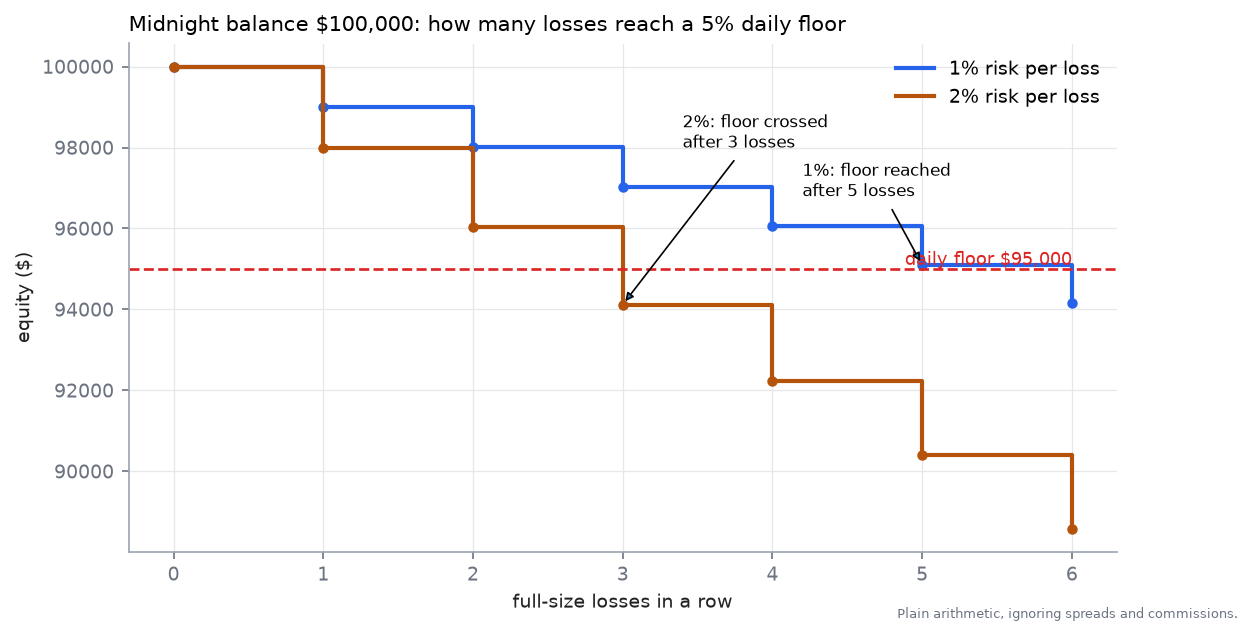
What to notice: That at 2% the floor is crossed after three losses, and at 1% after five.
Example 2: floating loss is already counted
Balance at midnight $100,000, floor $95,000. During the day:
1. One trade closed with a loss of $1,500, so balance is $98,500.
2. Two open positions are floating at −$3,000 in total.
3. Equity is $98,500 − $3,000 = $95,500, only $500 above the floor.
No stop-loss has been hit, but the account is $500 from failing. If a swap or commission of $60 is also charged, the margin is $440. Checking only your closed trades would have shown $98,500 and a false sense of safety.
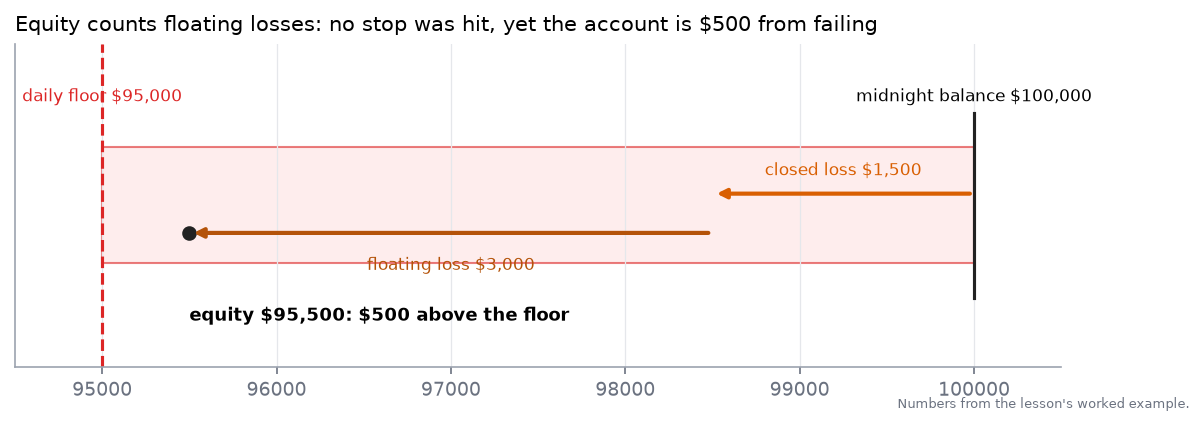
What to notice: The $500 gap to the floor.
Example 3: the gap
A trader opened a 3-lot long EUR/USD position near the Friday close and holds it over the weekend with a 30-pip stop, planning to risk about $900 (3 lots is 300,000 units, so one pip is about $30).
1. The planned loss is 30 × $30 = $900.
2. The actual gap to the open is 68.4 pips, so the loss is about 68.4 × $30 = $2,052.
3. That is 2.3 times the plan, and about 41% of the $5,000 daily allowance in one move, before anything else is counted.
Using the same maths, a smaller size (1 lot) would have lost about $684 on the gap, or 14% of the allowance. Weekend gaps are the reason many traders close or shrink positions on Friday.
How to apply it step by step
- Read the current rules of the programme you are considering, in full, including how and when the limits reset (the time zone matters).
- Write down the two floors in dollars for your account size, and what happens to each as the balance rises.
- Decide a personal daily loss stop well inside the firm’s limit (for example, a third to half of it) and treat it as the real limit.
- Choose risk per trade so that your personal stop needs several losses, not one or two. The position-sizing lesson shows the formula.
- Count open trades, swaps and commissions in your equity, not just closed results.
- Avoid or reduce positions over weekends and around major news, when gaps and slippage are largest.
- Keep a record of your equity at the firm’s reset time each day.
- Remember that the firm decides, so keep screenshots and statements of what happened.
Common mistakes
- Treating the loss limit as a target. A floor 5% away is not permission to risk 4% in a day.
- Forgetting that equity includes open trades. The account fails when equity touches the floor, even if no stop-loss was reached.
- Mixing up the clocks. The daily reset is at the firm’s time, so your “today” can differ from theirs.
- Using a static-limit mindset on a trailing-limit account. Profits raise the floor.
- Sizing for the average case. Slippage and gaps are the cases that end accounts.
- Assuming the rules stay the same. Firms change them, including this month.
When it works and when it does not
Knowing the rules does not make a method profitable. What it does is stop you from losing the account to a limit that you could have planned around. Conservative sizing and a personal daily stop help in nearly every case, because they keep normal losing runs far from the floor.
Rules written as continuous equity checks cannot be fully managed, though. A gap, a spike, a platform outage or a news release can move equity through a limit between two of your decisions. A paid evaluation is also a business with its own incentives: the fees are paid whether or not you pass, and we have no reliable pass-rate statistics to quote. Before paying, work out what the fee is relative to your other trading costs, and treat it as a cost.
Practice exercise
A two-step account of $50,000 has a daily loss allowance of 5% of the initial capital and a static maximum loss of 10%.
- What is the maximum loss floor?
- The midnight balance is $51,000. What is today’s daily floor?
- You risk 1% of the initial capital per trade. How many full losses reach the floor from the midnight balance, ignoring costs?
- The balance is $51,000 and two open trades are floating at −$1,100 in total, with $20 of swaps and commissions on those open trades. What is the equity, and how far is it above the daily floor?
Answers:
1. $50,000 − $5,000 = $45,000.
2. $51,000 − $2,500 = $48,500.
3. Risk per trade is $500. The distance from $51,000 to $48,500 is $2,500, so five full losses reach it exactly.
4. Equity is $51,000 − $1,100 − $20 = $49,880, which is $1,380 above $48,500.
Key terms
Prop firm – a company that offers simulated or funded accounts for traders who pass its evaluation.
Evaluation (challenge) – the paid test with a profit target and loss limits.
Maximum daily loss – the floor under equity for the current day.
Maximum loss – the overall floor under equity, static or trailing.
Trailing limit – a floor that rises with profits and never falls.
Equity – balance plus floating profit or loss, minus swaps and commissions.
Gap – a jump between one price and the next, typically over a weekend.
Slippage – the difference between the expected and the actual fill price.
Frequently asked questions
What is a daily loss limit in a prop firm challenge?
A floor under your equity for the day. In FTMO’s 2-Step rules it is the midnight balance minus 5% of the initial capital, recalculated each day at 00:00 Central European time.
Is the maximum loss static or trailing?
It depends on the programme. FTMO’s 2-Step programme uses a static floor of initial capital minus 10%, while its 1-Step programme uses an end-of-day trailing floor that can rise but never fall.
Do open trades count towards the loss limits?
Yes. The firm measures equity, which includes floating profit or loss on open positions and also swaps and commissions, so a position can breach the limit before it is closed.
How much should I risk per trade on a challenge?
There is no single right answer, but the arithmetic is clear: at 1% risk, five losses reach a 5% daily floor, and at 2% only three do. Many traders choose well under 1% and a personal daily stop inside the firm’s limit.
Can gaps break the rules even with a stop-loss?
Yes. A stop does not guarantee its price. In our data EUR/USD gapped 68.4 pips over the weekend of 6 to 9 March 2026, more than twice a 30-pip stop.
Are prop firm rules the same everywhere?
No. They differ between firms and between programmes of the same firm, and they change over time. Always read the current rules and any consistency or news restrictions before you pay.
Key takeaways
- Prop firm limits are hard floors on equity, checked continuously.
- The daily limit resets at the firm’s clock, from the midnight balance; the maximum loss may be static or trailing.
- Open trades, swaps and commissions count, so watch equity, not closed results.
- At 1% risk five losses reach a 5% floor; at 2%, three do.
- Gaps and slippage can make a loss much larger than the stop suggests.
- Rules differ and change, so read the current ones.
Quick quiz
Q1. A $100,000 two-step account has a 5% daily allowance and a midnight balance of $98,000. What is the daily floor?
A: $98,000 − $5,000 = $93,000.
Q2. Is a floating loss counted against the limit before the trade is closed?
A: Yes, because the limit applies to equity.
Q3. At 2% risk per trade, how many full losses breach a 5% daily allowance?
A: Three, since three losses are 6% of the initial capital.
Q4. What is the difference between a static and a trailing maximum loss?
A: A static floor stays at the initial capital minus the allowance; a trailing floor rises with the highest balance reached.
Q5. A position with a 30-pip stop gaps 68 pips against you over the weekend. What went wrong?
A: The stop does not guarantee its price, so the loss was more than twice the planned amount.
Q6. Why set a personal daily stop inside the firm’s limit?
A: To leave a margin for slippage, costs and open positions, so that a bad day ends your trading and not the account.
Going deeper
- Risk per trade and position sizing – the sizing formula used above.
- Drawdown and risk of ruin – losing streaks and recovery arithmetic.
- Where to place a stop loss – why stops can be missed by gaps.
- Order types, spreads and costs – swaps, commissions and spreads.