
What you will learn
- What a market order, a limit order and a stop order do, and what each one does and does not guarantee.
- How pending orders work on a typical platform (buy limit, buy stop, sell limit, sell stop, stop limit) and how stop-loss and take-profit orders fit in.
- What slippage, spread, commission and swap are, and how to add them into one number for a trade.
- Why the same trade can cost very different amounts at different times, with real figures from a demo feed.
The idea in plain words
Placing an order is telling your broker what you want to happen. The two questions you answer are “at what price?” and “when?”. An order can say “do it now, whatever the price is” or “do it only if the price is this good” or “do it when the price reaches this level”. Each choice trades certainty of getting a trade against certainty of the price you get.
Think of buying a train ticket. You can buy at the counter right now at whatever the price is (certain to travel, uncertain price). You can wait until the price drops to a number you set (certain price, but you may never travel). Or you can say “if the price rises above this level, buy anyway, because then I need to travel” (a trigger). Trading orders work the same way.
Costs are the second half of this lesson. Every trade costs something beyond price movement: the spread, sometimes a commission, and sometimes a charge for holding overnight. They are small per trade and large over many trades. Knowing exactly what you pay is a skill.
How it works
The three basic orders
The US Securities and Exchange Commission’s investor education site describes the three most common types:
– A market order is an order to buy or sell immediately. It guarantees that the order will be executed but not the price. It will generally fill at or near the current ask (for a buy) or bid (for a sell), but the last traded price is not necessarily the price at which it fills.
– A limit order is an order to buy or sell at a specific price or better. A buy limit can only fill at the limit price or lower, and a sell limit only at the limit price or higher. It controls the price, but it may never fill.
– A stop order, also called a stop-loss order, is an order to buy or sell once the price reaches a specified stop price. When the stop price is reached, the stop order becomes a market order. A buy stop is placed above the current price (often to limit a loss on a short position), and a sell stop below it (often to limit a loss on a long position).
The last point matters. Because a stop becomes a market order when triggered, it guarantees you will get out, but not the price you get out at.
Pending orders on a trading platform
MetaTrader 5, a platform widely used for forex and CFD trading, describes six pending orders, which are orders that wait until the price reaches a level:
– Buy Limit: buy at the ask price equal to or less than the order’s price. You use it when price is above your level and you expect it to fall to it.
– Buy Stop: buy at the ask price equal to or greater than the order’s price. You use it when price is below your level and you expect it to rise through it.
– Sell Limit: sell at the bid price equal to or greater than the order’s price. You use it when price is below your level and you expect it to rise to it.
– Sell Stop: sell at the bid price equal to or less than the order’s price. You use it when price is above your level and you expect it to fall through it.
– Buy Stop Limit and Sell Stop Limit: a stop order that, once the stop level is reached, places a limit order at a second price you set.
Two more orders attach to an open position. A Stop Loss closes the position if price reaches a level against you, to limit the loss. A Take Profit closes it when price reaches a level in your favour. Both are set as prices, and both close the whole position when reached.
A simple memory aid: a limit order waits for a better price, and a stop order waits for a worse or breakout price and then acts.
Slippage
Slippage is the difference between the price you expected and the price you got. A market order can slip because the quote moves between the moment you click and the moment the order fills. A stop order can slip because it becomes a market order when triggered, and the market may have moved past the stop price by then. In fast markets or after a gap (a jump between one candle’s close and the next open, common after a weekend) slippage can be large. A limit order does not slip against you, because it fills only at its price or better, but it may not fill.
The costs: spread, commission, swap
Spread. You buy at the ask and sell at the bid, so every trade starts with a loss equal to the spread. The investor education site Investor.gov notes that the spread is an inherent cost of trading, and that the wider it is, the more it costs to buy and sell.
Commission. Some brokers charge a fee per trade. Investor.gov warns that others build their charge into a wider spread, that “commission-free” does not mean free, and that some dealers charge both a commission and a mark-up.
Swap (overnight financing). A position still open at the daily rollover time can be charged or credited a swap. MetaTrader 5 describes several swap modes: in one the swap is expressed in points, and in another it is an annual interest rate applied to the instrument’s price (the platform’s documentation uses a 360-day year). It also lets a broker choose one weekday on which a three-day swap is charged, to cover the weekend.
Here are real figures from the demo feed we use, for one standard lot:
| Instrument | Swap mode | Long | Short | Triple-swap day |
|---|---|---|---|---|
| EUR/USD | points | −8.53 points | +0.21 points | Thursday |
| XAU/USD (gold) | points | −61.31 points | −4.20 points | Thursday |
| BTC/USD | annual interest on price | −30% a year | −30% a year | Saturday |
On this feed one point on EUR/USD is worth $1 per standard lot, so holding one lot long costs $8.53 per night. On 0.10 lot that is $0.853, and 0.01 lot $0.085. For gold one point is $1 per lot (100 ounces), so a long lot pays $61.31 a night, about $0.61 per ounce. For Bitcoin at a price of 82,187 the annual charge works out to 82,187 × 0.30 ÷ 360 = $68.49 per night for one Bitcoin. These are one broker’s demo values at one moment. Swaps change, and a real account will differ. The point is that holding costs are not zero, and they differ a lot between instruments and between long and short.
Spreads change through the day
We looked at the spread recorded on 3,000 hourly candles from the same feed (EUR/USD from 24 April to 16 October 2026, gold from 16 April to 16 October). The spread is quoted in points (one point is a tenth of a pip for EUR/USD and one cent for gold):
– EUR/USD: the spread recorded on the candle at 00:00 server time averaged 23 points (2.3 pips), against about 0.2 points for most other hours. The three widest candles were Monday openings, at 37, 38 and 60 points (3.7 to 6.0 pips).
– Gold: the spread was between 38 and 41 points ($0.38 to $0.41) at most hours, and rose to an average of 47 points around 01:00 server time. The widest was 91 points ($0.91), on Wednesday 22 April at 01:00.
The demo feed’s spreads are very tight in quiet hours, which a live account will not match. The pattern is the useful part: the spread was widest around the daily rollover and the Monday open, which are the moments you are least likely to want to trade.
Margin close-out and negative balance protection
If your losses grow, a leveraged account can reach a point where the broker closes positions automatically (a margin close-out). In the EU, ESMA’s 2018 measures for retail CFD clients included a margin close-out rule and a negative balance protection on a per-account basis, which is meant to limit a retail client’s losses to the funds in the account. The US investor guide from 2011 warns that in off-exchange forex you may lose more than your initial deposit, depending on the agreement with the dealer. Rules differ by country and broker, so read your own broker’s terms.
Worked examples
Example 1: add up the real cost of a trade
A trader buys 0.10 lot of EUR/USD (10,000 euros, $1 per pip). All figures below except the swap are hypothetical, chosen to show the arithmetic.
1. Spread: 1.0 pip, which is $1.00 at $1 per pip.
2. Commission: $0.50 each way, $1.00 round trip.
3. Swap: the trade is held through three ordinary nights. At −8.53 points per standard lot, 0.10 lot pays 0.853 per night, so 3 × $0.853 = $2.56.
4. Total cost: $1.00 + $1.00 + $2.56 = $4.56, which is 4.6 pips at $1 per pip.
5. If the target is 20 pips, costs consume 4.56 ÷ 20 = 23% of the target before the market has to do anything. If the same trade crosses the Thursday rollover (three days charged at once), that single night costs 3 × $0.853 = $2.56.
The lesson is simple: write the full cost next to the target before you enter, not just the spread.
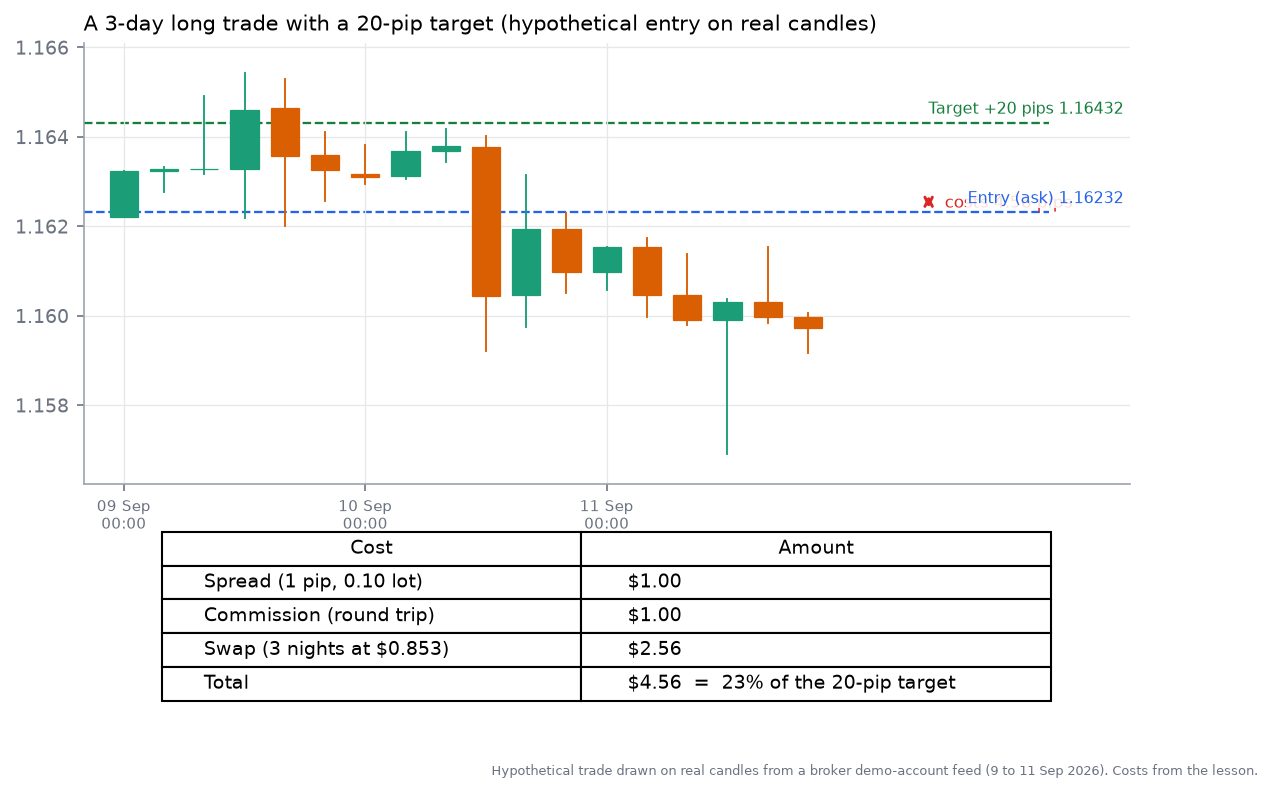
What to notice: That the costs sum to nearly a quarter of the target distance.
Example 2: a stop order filled through a weekend gap
This example uses a real gap on the demo feed’s daily candles. On Friday 6 March 2026 EUR/USD closed at 1.16126. On Monday 9 March it opened at 1.15442, which is 68.4 pips lower.
1. A trader holds a long position and sets a sell stop 30 pips below Friday’s close, at 1.15826.
2. A sell stop becomes a market order when the price reaches the stop level. Over the weekend the price did not trade between 1.16126 and 1.15442, so the first available price below the stop was around Monday’s open.
3. The order is triggered and fills near 1.15442, not at 1.15826. The loss is about 68.4 pips instead of the 30 pips planned. The difference of 38.4 pips is slippage.
4. For scale, on this feed the median weekend gap over roughly the last year of daily candles (60 weekends for EUR/USD, 59 for gold) was 6.25 pips for EUR/USD and $6.91 for gold, and the largest gold weekend gap was $85.63 (Monday 15 June 2026, from 4,214.90 up to 4,300.53).
Most weekends are small, and one in a while is large. A stop-loss is the best tool you have for limiting a loss, but it is not a guarantee of the exit price, and a position held over a weekend carries gap risk that no order type removes.
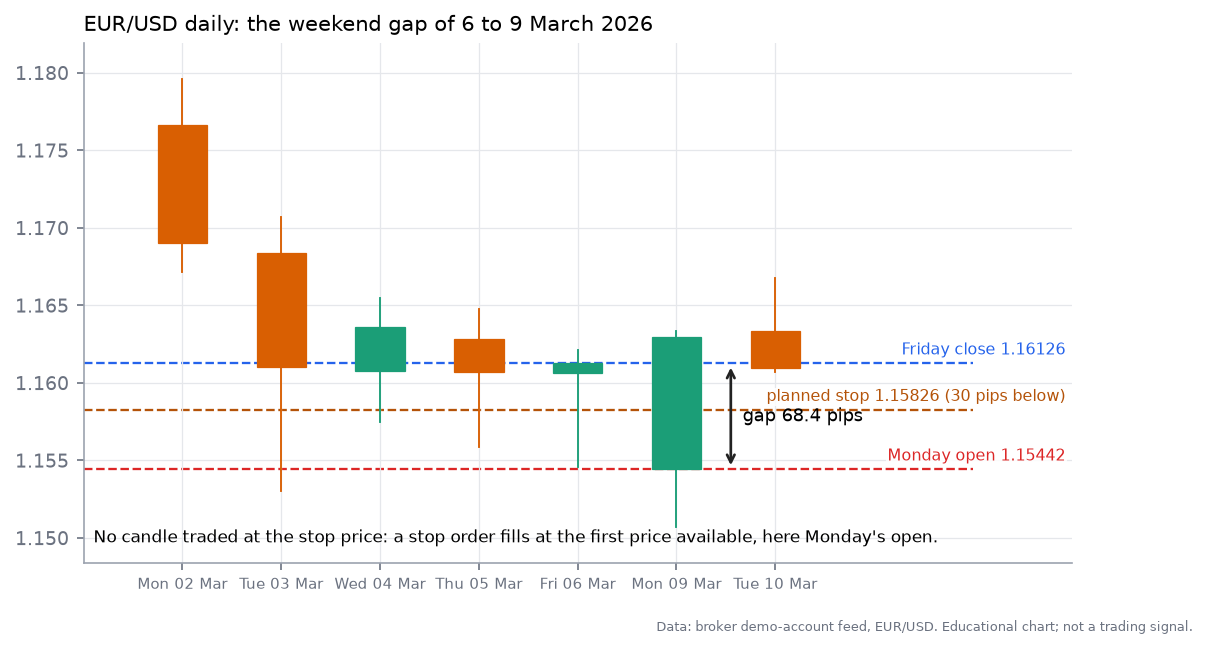
What to notice: That no candle trades at the stop price.
How to apply it step by step
- Open a demo account and find the order ticket for one instrument.
- Place a market order at the smallest size. Note the entry price, the spread and the fill.
- Place a buy limit below the price and a sell stop below the price. Write down which one fills if price falls.
- Add a stop loss and a take profit to an open position. Note the distance in pips and in money.
- Open the contract specification and find the swap for long and short. Write the cost per night for your size.
- Check the spread at two different times of day, and again in the hour around the Monday open if you can.
- Fill in this line before each trade: spread + commission + swap for the expected holding time = total cost, and cost ÷ target = share of target.
Common mistakes
- Using a market order in a fast market. The price can move between your click and the fill. Check the spread first, and consider a limit order if the market is racing.
- Thinking a stop-loss guarantees the exit price. A stop becomes a market order, so it can fill beyond the stop price, especially over a gap.
- Confusing limit and stop. A limit waits for a better price, a stop waits for a worse or breakout price and then acts. Placing the wrong one can open a trade at once.
- Ignoring swap. Holding costs are small each night but add up, and they can be larger on one side. Check long and short values.
- Trading at the rollover or the Monday open. Spreads were widest at those times on our feed.
- Judging a broker by the advertised spread. Compare the full cost, including commission and swap, and look at the live quote.
When it works and when it does not
Order types let you decide how much certainty you want on price and how much on execution. They work as designed in normal markets. They work less well in thin or fast markets and across gaps, when a stop can fill far from its level and a limit may never fill. No order type removes slippage on a stop, and no order protects you from a market that does not trade at your price.
The cost figures here are real but narrow. They come from one demo feed, over specific windows, and at one moment for the swaps and contract details. Live accounts differ, brokers differ and rules change. Use the method, not the numbers: write down every cost before you enter and check the live values on your own platform.
Practice exercise
A trader buys 0.20 lot of EUR/USD (20,000 euros, $2 per pip). The spread is 1.5 pips, commission is $2.00 round trip, and the long swap is −8.53 points per standard lot per night (one point is $1 per standard lot). The trade is held for two ordinary nights and the target is 25 pips.
- What is the spread cost in dollars?
- What is the swap for two nights?
- What is the total cost in dollars and in pips?
- What share of the 25-pip target is that?
- A sell stop is set at 1.2000 and price gaps from 1.2020 to 1.1985. Where might the order fill, and what is the slippage?
Answers:
1. 1.5 pips × $2 = $3.00.
2. Per night 8.53 × 0.20 = $1.706, so two nights = $3.41.
3. $3.00 + $2.00 + $3.41 = $8.41, which is 8.41 ÷ 2 = 4.2 pips.
4. 4.2 ÷ 25 = 17%.
5. It becomes a market order when the price passes 1.2000, so it fills near 1.1985, about 15 pips past the stop. The slippage is about 15 pips.
Key terms
Market order – an order to buy or sell immediately at the current price; execution is guaranteed, price is not.
Limit order – an order to buy or sell at a set price or better; the price is controlled, execution is not guaranteed.
Stop order – an order that becomes a market order once a stop price is reached.
Pending order – an order that waits until price reaches a level before it acts.
Stop loss / take profit – orders attached to a position that close it at a loss limit or at a profit target.
Slippage – the difference between the expected price and the price actually obtained.
Spread – the difference between the ask and the bid.
Swap – a charge or credit for holding a position past the daily rollover.
Margin close-out – the automatic closing of positions when losses use up the margin.
Frequently asked questions
What is the difference between a market order and a limit order?
A market order fills immediately at the current price and is certain to execute, but the price can differ from what you saw. A limit order fills only at its price or better and may never fill. One controls execution, the other controls price.
Does a stop-loss guarantee my exit price?
No. A stop order becomes a market order when its price is reached, so it fills at the next available price, which can be worse than the stop, particularly over a gap. In our example a stop 30 pips from Friday’s close would have filled around 68 pips away after a weekend gap.
What is slippage?
It is the difference between the price you expected and the price you got. It happens on market orders when the quote moves before the fill, and on stop orders when price moves past the stop. It is usually small in calm markets and larger in fast ones.
What is a swap and who pays it?
A swap is a charge or credit for keeping a position open past the daily rollover. Whether you pay or receive depends on the instrument and on whether you are long or short. On our demo feed a long EUR/USD position paid and a short received a small amount, while gold paid on both sides.
Why was the spread wider at certain times?
On our feed the spread was widest around the daily rollover and at the Monday open, when few participants trade. Spreads also widen around major news. Check the live quote before you trade.
Can I lose more than my deposit?
It depends on your broker and country. EU retail CFD accounts have negative balance protection under ESMA’s measures, while the US investor guide warns that in off-exchange forex you may lose more than your deposit. Read your broker’s terms.
Key takeaways
- A market order guarantees execution, not price. A limit order controls price, not execution. A stop becomes a market order when triggered.
- Pending orders (buy limit, buy stop, sell limit, sell stop) wait for a price level. Stop loss and take profit attach to open positions.
- A stop-loss limits the planned loss but not the exit price, and a gap can fill a stop far from its level.
- Total cost is spread plus commission plus swap. Add it up and compare it with the target before you trade.
- Spreads and swaps vary by time, instrument and broker, so check the live values.
Quick quiz
Q1. Which order type guarantees execution but not price?
A: A market order.
Q2. Price is 1.1050. You want to buy if it falls to 1.1020. Which pending order is that?
A: A buy limit.
Q3. Price is 1.1050. You want to buy if it rises through 1.1080. Which pending order is that?
A: A buy stop.
Q4. Spread 2 pips, commission $1.00 round trip, swap $0.80, position worth $1 per pip, target 20 pips. What share of the target is the cost?
A: Cost = $2.00 + $1.00 + $0.80 = $3.80, which is 3.8 pips, and 3.8 ÷ 20 = 19%.
Q5. Why can a stop-loss fill far from its price over a weekend?
A: It becomes a market order when triggered, and the first available price after a gap may be well beyond the stop.
Q6. Why can a limit order avoid negative slippage?
A: It fills only at its price or better. The cost is that it may not fill at all.
Going deeper
- What is trading and how markets work – the bid, ask and spread basics.
- Forex, gold and crypto compared – how costs differ by instrument.
- Risk per trade and position sizing – turn a stop distance into a position size.
- How to check a forex broker – check the licence and the full costs before you deposit.
- Profit and loss calculator – gross and net result of a trade, with spread, commission and swap.
- Market maker vs ECN brokers – what an account type changes about spread and commission.