
What you will learn
- What trading is, how it differs from long-term investing, and what you are actually doing when you “buy” or “sell” a market.
- Who takes part in a market and how bid prices, ask prices and the spread are formed.
- How to read a price quote, count pips and work out profit, loss and trading cost with simple arithmetic.
- What leverage and margin do, why they magnify losses as well as gains, and what regulators and data say about how retail traders fare.
The idea in plain words
Imagine a busy street market. Dozens of people sell tomatoes and dozens want to buy them. Each seller has a lowest price they will accept, and each buyer has a highest price they will pay. When a buyer’s maximum and a seller’s minimum meet, a deal happens, and that deal price becomes the latest price everyone sees. A financial market is the same idea, with two differences: the goods are things like currencies, shares, gold or crypto-assets, and the deals happen electronically, thousands of times a minute.
A market is any place or network where buyers and sellers are matched and prices are discovered. A price is simply the level at which the last deal happened. Prices move because the balance of eager buyers and eager sellers keeps changing. If more people want to buy than sell at the current price, the price has to rise until enough sellers are tempted in. If more want to sell, it has to fall.
Trading means buying and selling in order to profit from price changes over a short to medium time, from minutes to a few weeks. Investing usually means holding an asset for years, with returns coming from things like company profits, interest or long-term growth. Both involve risk, but they ask different questions. An investor asks “is this asset worth owning for a long time?” A trader asks “where might price go over the next few hours or days, and how much am I willing to lose if I am wrong?” This course is about the second question, and it spends as much time on the word “lose” as on the word “profit”.
A trader does not need to own anything to take part. Because most retail trading uses contracts that track a price, you can profit from a fall as well as a rise. Buying first is called going long. Selling first, hoping to buy back cheaper, is called going short. A long trade gains when the price rises. A short trade gains when the price falls. Either can lose, and either can lose quickly.
One more point before the mechanics. For a derivative contract such as a forex or CFD trade, one side’s gain is the other side’s loss before costs. After costs (spread, commission, financing), traders as a group end up behind. That is why this lesson, and every lesson on this site, treats protecting your money as the first skill and finding trades as the second.
How it works
Who is in the market
Markets are made of participants with very different goals. Central banks manage currencies and interest rates. Banks and dealers quote prices and trade for clients and for themselves. Companies trade currencies because they pay suppliers or receive income in another country. Investment funds and hedge funds trade in large size. Finally there are retail traders, individuals like you who usually trade small amounts through a broker. The Bank for International Settlements (BIS) Triennial Survey put global foreign-exchange turnover at about $7.5 trillion per day in April 2022 and about $9.5 trillion per day in April 2025 (the first release in September 2025 said $9.6 trillion; the BIS’s later Quarterly Review gives $9.5 trillion, and April 2025 was unusually busy because of tariff news). The point of those numbers is scale: a retail order is tiny, and no single small trader moves the market.
Most participants are not trying to beat each other with chart reading. A company converting euros to dollars to pay an invoice is not forecasting anything. This matters because it means price is driven by a mix of reasons, many of them unrelated to charts, and charts only record the result.
Where trades happen: exchanges and over-the-counter
An exchange is a central venue with a visible order book. Shares and futures trade this way. Futures usually have one main venue, while a share can be quoted on several venues whose prices are combined into one consolidated feed. The foreign-exchange market is different. It is over-the-counter (OTC), which means dealers deal directly with each other and with clients, with no single central exchange. As a result there is not one exchange rate at one moment but several close ones, and smaller participants usually get wider spreads than the largest banks do. Trading runs roughly around the clock on weekdays, passing from Asia to Europe to North America, with the United Kingdom the largest trading location (about 38% of turnover in the BIS surveys for both 2022 and 2025).
For you as a retail trader, the practical effect is that the price you see comes from your broker’s feed. Two brokers can show slightly different prices for the same instrument at the same second. That is normal, and it is one reason a chart on one platform may not match another exactly.
Bid, ask and spread
Every tradable instrument has two prices at any moment. The bid is the highest price buyers are currently willing to pay. The ask (also called the offer) is the lowest price sellers are currently willing to accept. The ask is always above the bid. The gap between them is the spread.
When you want to buy right now, you pay the ask. When you want to sell right now, you receive the bid. So a trade that opens and closes immediately loses the spread. The spread is the cost of immediacy: you are paying for being able to trade straight away rather than waiting for someone to meet your price. Spreads are narrow when many people are trading (high liquidity) and wider when few are, such as late at night, around major news releases, or in thinly traded instruments.
Example quote for EUR/USD: bid 1.0850, ask 1.0852. The spread is 1.0852 − 1.0850 = 0.0002.
Reading a currency quote and counting pips
A currency pair such as EUR/USD is quoted as “how many units of the second currency buy one unit of the first.” A quote of 1.0850 means 1 euro costs 1.0850 US dollars. The first currency (EUR) is the base, the second (USD) is the quote currency.
A pip is the standard smallest unit used for quoting most pairs: 0.0001, or the fourth decimal place. (Pairs involving the Japanese yen are usually quoted to two decimals, so a pip there is 0.01.) A move from 1.0850 to 1.0870 is 0.0020, which is 20 pips. In the quote above, the spread of 0.0002 is 2 pips. Many platforms also show a fifth decimal, a fraction of a pip often called a pipette.
Position size and what a pip is worth
Currency trades are measured in units of the base currency. By common convention a standard lot is 100,000 units, a mini lot is 10,000 units, and a micro lot is 1,000 units (brokers can define their own contract sizes, so always check the specification). For a pair quoted in US dollars, such as EUR/USD, one pip on one standard lot is worth 100,000 × 0.0001 = $10. On a mini lot (0.10 lot, 10,000 units) one pip is worth $1.
The profit or loss of a trade is therefore: number of pips × value per pip. Position size is covered in depth in Risk per trade and position sizing, and the Position Size Calculator does the arithmetic for you.
Contracts, not ownership
Much retail trading of currencies, gold, indices and crypto-assets is done through contracts for difference (CFDs). A CFD is an agreement between you and your broker to exchange the difference between the price when you open the trade and the price when you close it. You never take delivery of the underlying asset. This is convenient and cheap to start, but it brings extra risk: the broker is your counterparty, you depend on its pricing, and leverage is built in.
Leverage and margin
Leverage lets you control a position larger than the money in your account. The money the broker sets aside from your account to keep the position open is called margin. With 30:1 leverage, the margin needed is 1/30 (about 3.3%) of the position’s full value, called its notional value.
Leverage does not change how far price moves. It changes how large your gain or loss is relative to your account. Regulators know this: in March 2018 the European Securities and Markets Authority (ESMA) agreed temporary limits on maximum leverage for retail CFD clients at 30:1 for major currency pairs, 20:1 for non-major pairs, gold and major indices, 10:1 for other commodities, 5:1 for individual shares and 2:1 for crypto-assets. ESMA’s temporary measures lapsed on 31 July 2019, by which time most national regulators in the EU had adopted permanent measures at least as strict. The limits step down as the volatility of the underlying instrument goes up. ESMA gave the reason alongside those limits: it reported that national authorities found 74–89% of retail CFD accounts typically lose money. Rules differ by country, so those limits do not apply everywhere.
Costs beyond the spread
Besides spread, brokers may charge a commission per trade, and a financing (swap or overnight) charge for positions held past the daily rollover. These costs are small per trade but are charged every time, win or lose, so they matter most to people who trade very often.
Why prices move
In the short run, price moves when order flow changes: a news release, a central bank decision, a large order, a change in mood. In the long run, prices relate to fundamentals such as interest rates, inflation, economic growth and company earnings. Technical analysis, which this course teaches, studies the price history itself. There is a long-running academic debate about how much that history can predict. The weak form of the efficient-market hypothesis (set out by Eugene Fama in the Journal of Finance, 1970) says current prices already reflect past prices, which would mean chart patterns cannot reliably beat the market after risk and costs. Evidence for the stronger forms is mixed and criticised, but the point for a beginner is simple: no one has shown that chart reading is an easy edge, and you should treat every technique in these lessons as something to test, not something to trust.
Worked examples
Example 1: a long trade that works
A trader opens a demo trade on EUR/USD with a mini lot (0.10 lot, 10,000 units), so one pip is worth $1.
- The quote is bid 1.0850 and ask 1.0852. The trader goes long, so the order fills at the ask, 1.0852.
- Price rises. Later the quote is bid 1.0872 and ask 1.0874. The trader closes by selling at the bid, 1.0872.
- The move from entry to exit is 1.0872 − 1.0852 = 0.0020, which is 20 pips.
- Gross result: 20 pips × $1 = +$20.
- The cost of crossing the spread was already included, because the trader bought at the ask and sold at the bid. At entry the spread was 2 pips = $2.
- Margin check at 30:1: notional value = 10,000 × 1.0852 = $10,852. Margin = $10,852 ÷ 30 = $361.73.
The $20 gain is 20 ÷ 361.73 = 5.5% of the margin used, even though price moved only about 0.18% (0.0020 ÷ 1.0852). That is leverage at work.
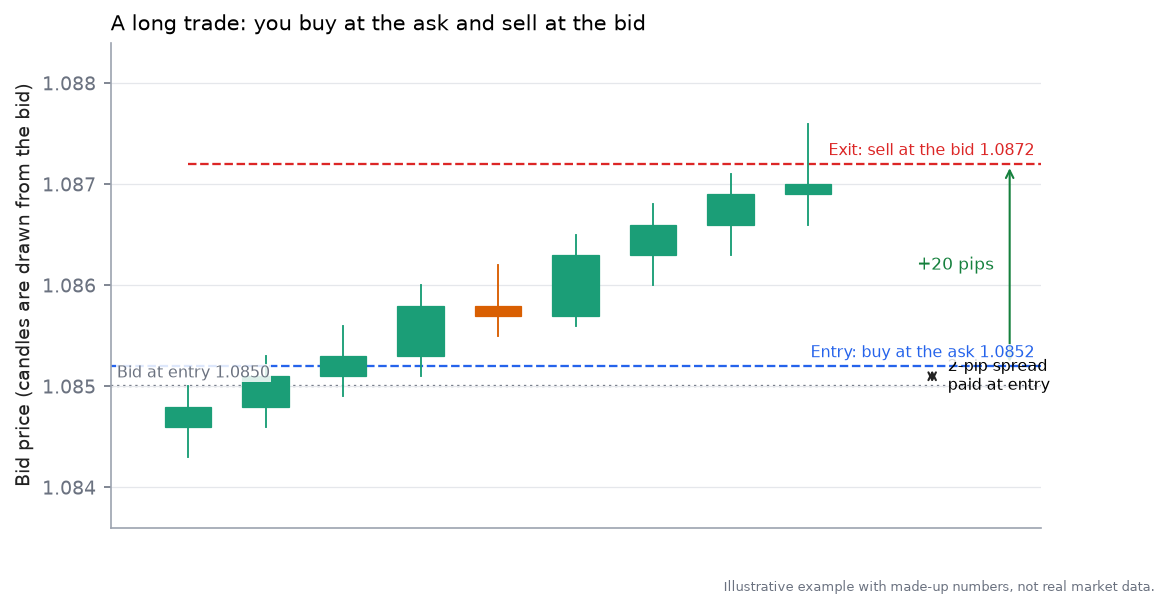
What to notice: That the exit price shown on the chart is the bid, not the last candle’s close.
Example 2: price rises, trade loses
The same trader opens another mini-lot long trade, but price barely moves.
- Opening quote: bid 1.0850, ask 1.0852. The trader buys at 1.0852.
- Price edges up. The new quote is bid 1.0851, ask 1.0853. The middle price (the midpoint between bid and ask) has risen by 1 pip, from 1.0851 to 1.0852.
- The trader closes by selling at the bid, 1.0851.
- Result: 1.0851 − 1.0852 = −0.0001 = −1 pip = −$1.
The market “went up”, yet the trade lost, because the trader paid the spread to get in and out. A single trade like this is trivial, but a trader who does 200 such round trips a month would pay the spread 200 times. This is the cost side of trading that beginners tend to ignore.
Now the leverage side. Suppose the trader had instead gone long at 1.0852 and price fell 1% against the position, to about 1.0743.
- Loss = 1.0852 − 1.0743 = 0.0109, which is 109 pips.
- At $1 per pip the loss is 109 × $1 = −$109.
- Compared with the $361.73 margin, that is 109 ÷ 361.73 ≈ 30% of the margin from a 1% price move.
Leverage works equally in both directions. An ordinary 1% move can consume nearly a third of the margin on a trade that was meant to be small.
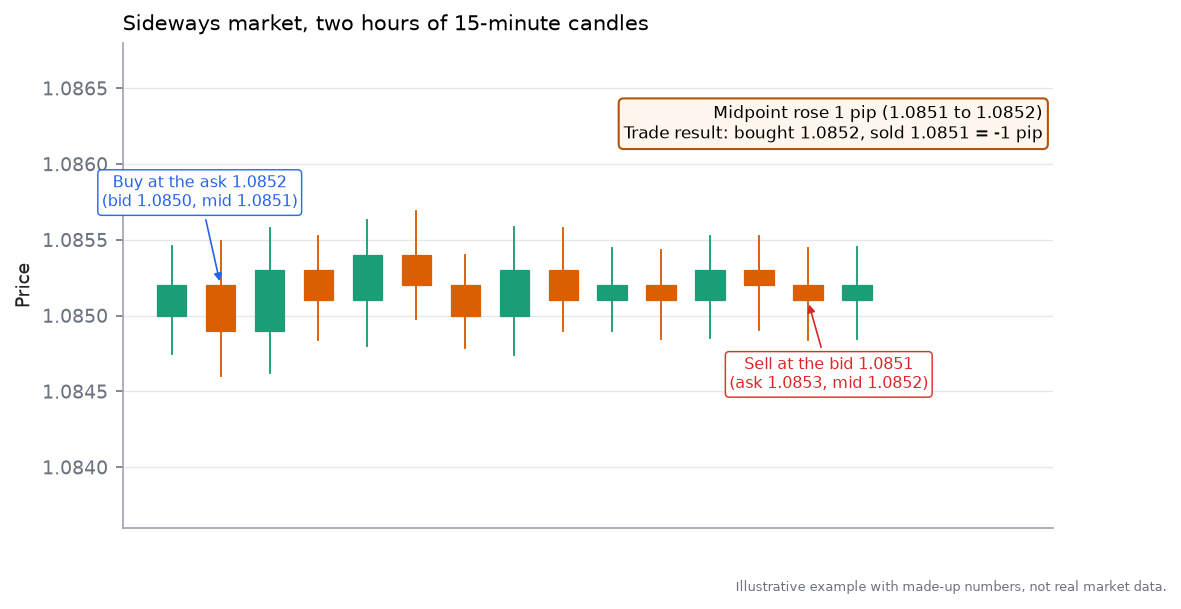
What to notice: That the candle body direction and the trade result can disagree.
How to apply it step by step
This is a demo-account routine. Do it before you think about real money.
1. Open a free demo account with any broker that offers one, and choose one instrument to watch, such as EUR/USD. Any broker’s demo is fine for this.
2. Find the bid and ask on the platform. Write both down and compute the spread in pips.
3. Check the contract size and what one pip is worth for the lot size you plan to use.
4. Open the smallest position the platform allows. Note the entry price, the margin used and the cost of the spread in money.
5. Close the position after a few minutes. Record the exit price and compute the result in pips and money. Check your arithmetic against the platform’s number.
6. Repeat on a different instrument or at a different time of day, and compare the spreads.
7. Write one or two sentences on what surprised you. Keep this note; it is the start of a trading journal.
Common mistakes
- Thinking price direction is the only thing that matters. It happens because charts show direction and hide costs. Always add the spread (and any commission or financing) to your picture of the trade before you enter.
- Using leverage because it is available. A broker may allow far more than you can afford to lose. Choose a position size from the amount you are willing to risk, not from the maximum leverage on offer.
- Treating a demo win as proof. A demo has no emotion and often fills at ideal prices. Use it to learn mechanics, not to decide you are ready.
- Trading without a rule for being wrong. A beginner opens a trade with only an idea of where to profit. Decide beforehand where the idea is proven wrong and how much that costs.
- Chasing a feeling that “it must turn now”. After a long move, price can keep going. Buying or selling because a move has gone far is not an edge. Replace the feeling with a written, testable rule.
- Ignoring the time of day. Spreads and movement are very different in a quiet late-night session and in the minutes after a major news release.
When it works and when it does not
Trading is a real activity with real participants, but it is not a reliable income source for most people who try it. Regulatory evidence is blunt. ESMA’s 2018 statement reported that 74–89% of retail CFD accounts typically lose money, with average losses per client between €1,600 and €29,000, which is part of why it restricted leverage and the sale of certain products to retail clients. That figure describes CFD accounts in Europe at that time and should not be read as a forecast for any individual, but it is a sober baseline.
Costs explain part of it. Spread and other charges are paid on every trade, so a strategy needs enough edge to cover them before it earns anything. Leverage explains another part: it makes small mistakes expensive. Behaviour explains the rest, because many people tend to sell winners early and hold losers too long, a pattern called the disposition effect, which Terrance Odean documented in the brokerage accounts of individual investors (Journal of Finance, 1998). Later lessons on risk per trade and trading psychology take these on directly.
What does work for a beginner is treating the first months as paid education done cheaply: learn the mechanics on a demo, keep risk per trade small, record every trade and test ideas before trusting them. Whether any particular technical method has a lasting edge is an open question, and the evidence on technical analysis is mixed: a survey of the research by Park and Irwin (Journal of Economic Surveys, 2007) sorted 95 modern studies into 56 with positive results, 20 negative and 19 mixed, but warned that many had weaknesses such as data snooping, rules chosen after the fact, and poor estimates of risk and trading costs, and called for better testing before the question can be settled. Nothing in this course should be read as a promise that a method will work.
Practice exercise
Work through these with pen and paper, then check against the answers.
Quote: GBP/USD bid 1.2700, ask 1.2703. Position: 0.10 lot (10,000 units). One pip on this size = $1. Leverage available: 30:1.
- What is the spread in pips and in dollars?
- You go long and close at a bid of 1.2745. What is the result in pips and dollars?
- What notional value and margin does the position need at the opening ask?
- If price instead fell to a bid of 1.2655 before you closed, what would the loss be?
Answers:
1. Spread = 1.2703 − 1.2700 = 0.0003 = 3 pips = $3.
2. Entry at the ask 1.2703, exit at the bid 1.2745. Move = 0.0042 = 42 pips, so +$42.
3. Notional = 10,000 × 1.2703 = $12,703. Margin = 12,703 ÷ 30 = $423.43.
4. Exit at 1.2655. Move = 1.2655 − 1.2703 = −0.0048 = −48 pips = −$48, which is 48 ÷ 423.43 ≈ 11.3% of the margin.
As an extra step, open the same trade on a demo account and compare your numbers to the platform’s.
Key terms
Market – a place or network where buyers and sellers are matched and prices are found.
Bid – the highest price buyers are currently willing to pay.
Ask (offer) – the lowest price sellers are currently willing to accept.
Spread – the difference between ask and bid; the cost of trading immediately.
Pip – the standard small price unit, 0.0001 for most currency pairs and 0.01 for yen pairs.
Lot – a standard trade size; one standard lot is 100,000 units of the base currency.
Leverage – controlling a larger position than your own money by using borrowed exposure; magnifies gains and losses.
Margin – the money set aside from your account to keep a leveraged position open.
Long / short – buying first expecting a rise / selling first expecting a fall.
CFD – a contract for difference: an agreement to exchange the price change between opening and closing, without owning the asset.
Frequently asked questions
What is trading in simple terms?
Trading is buying and selling a market with the aim of profiting from price changes over a short to medium period. Unlike long-term investing, a trader focuses on price movement and on controlling the amount lost if the idea is wrong. Because the average retail trader loses money after costs, learning risk control comes before learning entries.
Is trading the same as gambling?
They share uncertainty, but they are not identical. A trade can be planned with a defined risk, a written rule and a record you can test over many trades, whereas most casino games have a built-in disadvantage you cannot change. Trading without a plan, with oversized positions, behaves much like gambling, which is why the planning lessons come early in this course.
Do I need a lot of money to start trading?
No. You can learn the mechanics on a free demo account with no money at risk, and brokers allow small positions such as micro lots. The more useful question is how much you can afford to lose without it affecting your life, because that is the money that should be put at risk and the starting amount should be small.
Why do I buy at one price and sell at another?
Because every market has a bid and an ask. You buy at the ask and sell at the bid, and the gap between them is the spread, the cost of trading immediately. The spread is why a trade that opens and closes straight away shows a small loss.
What does leverage like 30:1 actually mean?
It means the broker requires margin of about 1/30 of the position’s value. A position worth $10,000 would need roughly $333 of margin. It does not make price move more, but it makes your gains and losses larger relative to your account, so a small price move can use up a large part of your margin.
Can I make a living from trading?
Some people do, but regulators’ data suggest that most retail accounts lose money, and no technique is known to work for everyone. Treat income from trading as uncertain and never rely on it to pay essential bills. Focus first on learning, risk control and keeping records.
Key takeaways
- A market sets prices through the interaction of buyers and sellers; a price is just the level of the last agreed deal.
- You buy at the ask and sell at the bid, so every trade starts with the cost of the spread.
- Pips and lot size turn price moves into money: pips × value per pip.
- Leverage multiplies gains and losses alike; a 1% price move on a 30:1 position used about 30% of its margin in the example above.
- Regulator data report that most retail CFD accounts lose money, so risk control and testing come before looking for trades.
Quick quiz
Q1. What is the difference between the bid and the ask?
A: The bid is the highest price buyers will pay now; the ask is the lowest price sellers will accept. The ask is higher, and the gap is the spread.
Q2. A quote shows bid 1.2000 and ask 1.2003 for a pair where one pip is 0.0001. What is the spread in pips?
A: 1.2003 − 1.2000 = 0.0003, which is 3 pips.
Q3. You buy 0.10 lot (10,000 units) of EUR/USD at 1.0852 and close at a bid of 1.0832. One pip is worth $1. What is the result?
A: The move is 1.0832 − 1.0852 = −0.0020, which is −20 pips, so the result is −$20.
Q4. Why can a trade lose money even though the middle price rose slightly?
A: You enter at the ask and exit at the bid, so the spread is paid. If the rise is smaller than the spread, the trade is a net loss.
Q5. At 30:1 leverage, what margin is needed for a position with a notional value of $15,000?
A: $15,000 ÷ 30 = $500.
Q6. Name two reasons a beginner should be cautious about high leverage.
A: It magnifies losses relative to the account, so a small price move can consume a large share of margin; and it makes it easy to take a position far larger than the money you can afford to lose.
Going deeper
- Order types, spreads and costs – how orders are placed and what each one really costs.
- How to read a candlestick chart – turn the price data in this lesson into a chart you can read.
- Your first trading plan – put rules around everything above before you risk money.
- How to check a forex broker – verify the licence, find the real costs and test withdrawals before you deposit.