
What you will learn
- What FOMO (“fear of missing out”) and revenge trading are, and how to recognise each in your own behaviour.
- What a study of professional futures traders found about taking more risk after morning losses.
- What happened in our test of entering the direction of a very large candle, on five instruments.
- How doubling risk after a loss compounds the damage, with arithmetic you can check.
- A short set of rules that interrupts both patterns.
The idea in plain words
FOMO is the urge to enter a trade because price is moving without you. A candle runs, a post shows someone’s profit, and you feel that the opportunity is leaving. You enter late, usually near the end of the move, with no plan and with a stop wherever it feels comfortable.
Revenge trading is the urge to win back a loss immediately. You take a loss, feel the sting, and take the next trade larger, sooner or with less care, as if the market owed you the money.
They look different but share a root: your decision is driven by how you feel about the last few minutes instead of by your plan. They also share a remedy: a rule written in advance, as the previous lesson described.
How it works
Loss aversion and the pull of the loss
Loss aversion is the idea, central to Kahneman and Tversky’s prospect theory (Econometrica, 1979), that a loss weighs more heavily on people than an equal gain. We read the paper’s abstract, which says the value function is generally steeper for losses than for gains, but not the full text, so we use it here only as the source of the concept. The Locke and Mann working paper, cited in the previous lesson, describes the disposition effect as derived from that theory.
What the research on loss-chasing found
Joshua Coval and Tyler Shumway studied proprietary traders at the Chicago Board of Trade (Journal of Finance, 2005). Their abstract states that the traders appear highly loss-averse, regularly assuming above-average afternoon risk to recover from morning losses. It also reports that losing traders actively purchased contracts at higher prices and sold at lower prices than those that prevailed previously, but that the market appeared to distinguish these risk-seeking trades from informed trading, and that prices set by loss-averse traders were reversed more quickly. In other words, professionals do what revenge traders do: take more risk after losing, and pay for it in worse prices.
Overtrading
Barber and Odean (Journal of Finance, 2000) found that among 66,465 households at a large discount broker in 1991 to 1996, those who traded most earned an annual return of 11.4% while the market returned 17.9%. They offered overconfidence as an explanation. FOMO and revenge trading are two ways of overtrading.
The mechanics of chasing a move
When you enter after a big move, two things are true:
1. Your stop must sit behind the move to keep the same logic as a normal trade, which makes it far away, so either you risk more or you trade a smaller size.
2. The move has already happened. The question is whether it continues.
We tested the second question.
Our test: entering after a very large candle
Using the frozen demo-feed data (from a broker demo account, ending 15 October 2026), we looked at H4 and D1 candles on EUR/USD, GBP/USD, USD/JPY, gold and Bitcoin. A “chase” candle is one whose true range was at least two ATRs (14-period Wilder ATR measured on the previous candle) and which closed in the outer quarter of its range, in the direction of the move. The entry is at the close of that candle in the same direction. The stop and the target are each one ATR from the entry. We then counted which was reached first in the next 12 candles (stop first if both were touched in the same candle).
Results across the ten instrument-timeframe pairs, 465 events:
– The target was reached first in 226 (48.6%), the stop first in 235 (50.5%) and neither in 4 (0.9%).
– Of the decided trades, 49.0% hit the target first, with a standard error of 2.3 percentage points.
– A baseline of 14,719 entries on every candle, in an arbitrary direction that alternated with the candle number, gave 49.5% (standard error 0.4 points).
So after a very large directional candle, continuation by one ATR before reversal by one ATR was no more likely than for any random candle. The big candle gave no information about direction. The events overlap in time (big candles cluster), so the true uncertainty is larger than the standard error suggests, and the test covers a single feed and window.
The cost shows up in the stop. For the same events, the distance from the close to the far end of the candle, where a stop would go if you respected the candle’s own structure, was a median of 2.19 ATRs (middle half of events between 1.92 and 2.56, mean 2.34). A normal one-ATR stop sits at 1 ATR. To keep the same money at risk, the position behind the candle’s extreme must be about 1 ÷ 2.19 = 46% of the size.
Worked examples
Example 1: the doubling spiral
A trader risks 1% per trade and decides to double the risk after each loss to get back quickly.
1. Loss 1: risk 1%, cumulative loss 1%.
2. Loss 2: risk 2%, cumulative 3%.
3. Loss 3: risk 4%, cumulative 7%.
4. Loss 4: risk 8%, cumulative 15%.
5. Loss 5: risk 16%, cumulative 31%.
6. Loss 6: risk 32%, cumulative 63%.
Flat 1% risk would have lost 1%, 2%, 3%, 4%, 5% and 6% over the same sequence. With a 45% win rate, the probability of four losses in a row is 0.55⁴ = 9.15%, so this sequence is not rare: about one run of four trades in eleven ends this way. If the account were a prop firm account with a 5% daily limit, the third loss (cumulative 7%) would already end it.
Compounding the percentages on the current balance, four losses of 1%, 2%, 4% and 8% leave 0.99 × 0.98 × 0.96 × 0.92 = 85.7% of the starting balance, a loss of 14.3%. Recovering needs a gain of 1 ÷ 0.857 − 1 = 16.7%. Four flat 1% losses leave 0.99⁴ = 96.1%.
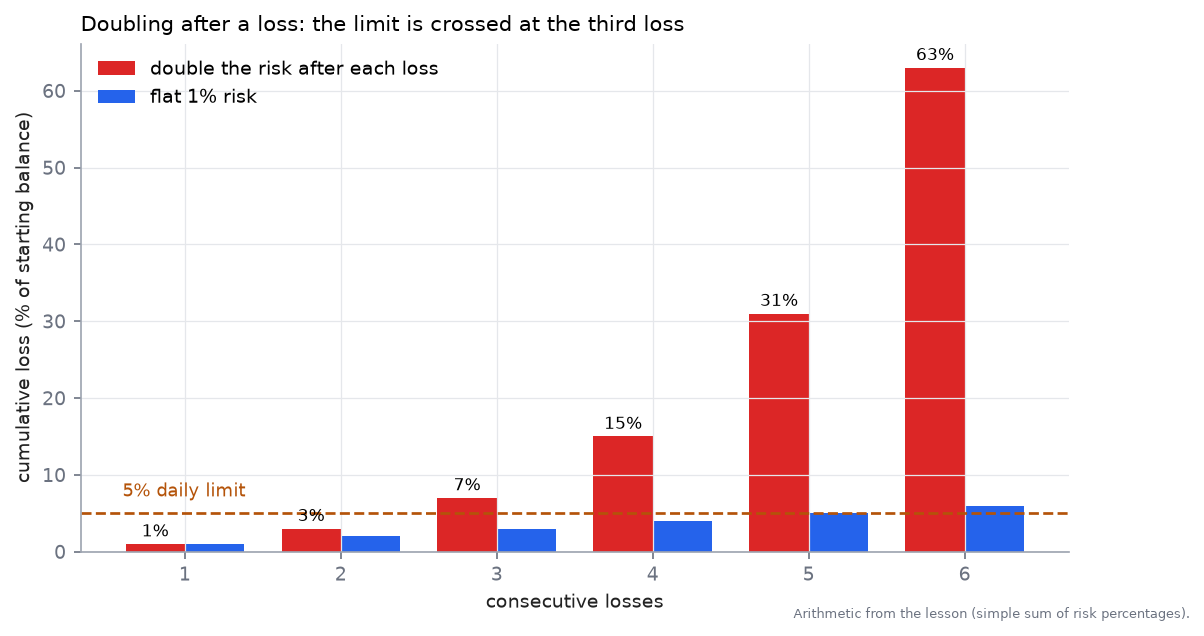
What to notice: That the gap widens fast and that 5% daily limit lines are crossed at loss 3.
Example 2: the chase and the size
You see EUR/USD move 2.2 ATRs on an H4 candle and it closes at the high. The ATR is 40 pips, so the candle’s range is about 88 pips.
1. A one-ATR stop is 40 pips. Behind the candle’s low, the stop would be near 88 pips away (the candle’s own range, since it closed at the high).
2. To risk 1% of a $10,000 account ($100), 40 pips allows $2.50 a pip (0.25 lot) and 88 pips allows $1.14 a pip (about 0.11 lot).
3. The test showed that the odds of continuing one ATR before reversing one ATR were about even (49.0%).
So the chase either takes a stop that is too tight for the candle’s structure or a position less than half the usual size, and in return offers roughly even odds. It is not an edge: it is a trade you would have declined if it had appeared on your list at the start of the day.
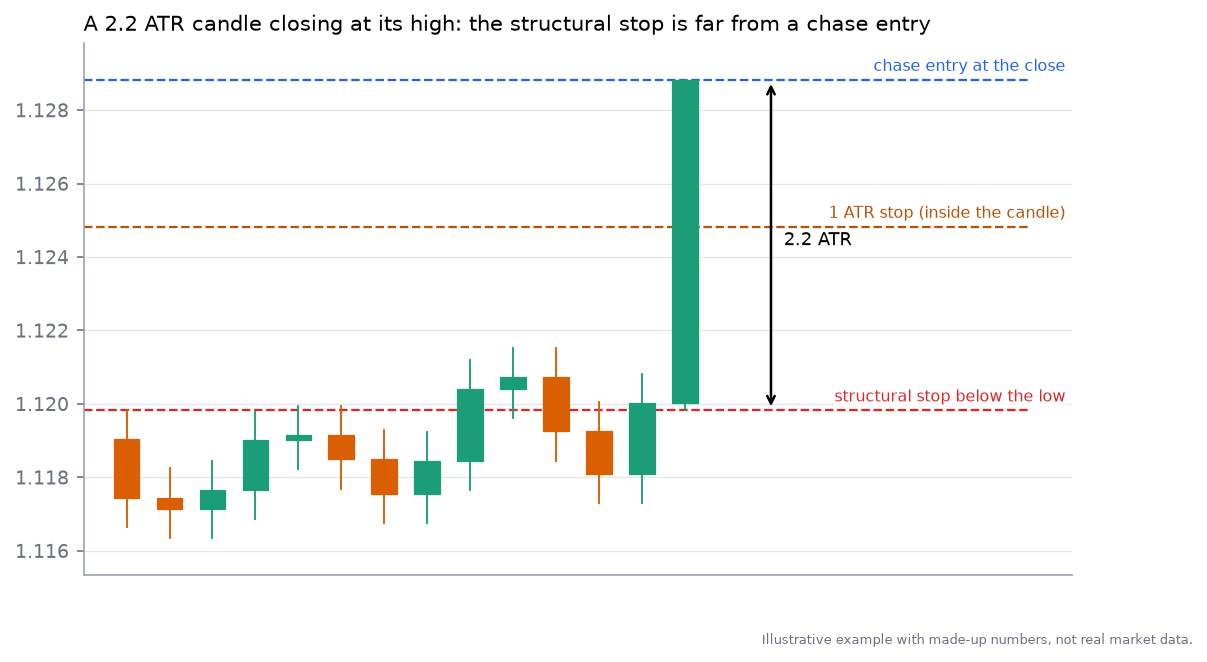
What to notice: How far the structural stop is from the entry.
Example 3: a cooling-off rule in action
Imagine a trader loses 1.5% on a trade at 09:20.
1. The rule says: after any loss over 1% I leave the desk for 30 minutes and write the journal entry.
2. At 09:50 the trader returns, reviews the chart and checks the plan. A setup is present, or it is not.
3. If it is, the trade is taken at the normal 0.5% risk.
The rule does not predict whether the next trade wins. It separates the decision from the feeling. That is all it is meant to do.
How to apply it step by step
- Name your triggers: which situations make you chase (a fast move, a post, a missed entry) or take revenge (a loss, a stop-out just before a reversal)?
- Write an if-then rule for each. For FOMO: “If I did not plan this entry, I do not take it”. For revenge: “If I lose more than 1%, I stop for 30 minutes”.
- Fix your risk per trade in advance, and never raise it after a loss.
- Set a daily loss limit and a maximum number of trades.
- Before every entry, write the reason and the stop. If you cannot, skip the trade.
- After a loss, log your state before anything else.
- If you missed a move, mark it on your chart and wait for a pullback or the next setup in your plan. Another opportunity will come.
- Review the journal weekly for the pattern: how many trades were taken within 30 minutes of a loss, and how did they do?
Common mistakes
- Treating a missed move as lost money. You did not own it, so you did not lose it.
- Doubling after a loss. It speeds up ruin, as the table shows.
- Moving the stop to avoid the loss. It turns a small controlled loss into a large one.
- Entering without a stop because the move is fast. Fast moves are when stops matter most.
- Trading to feel better. Wins and losses are not owed.
- Taking the next trade at once. A pause lets the feeling pass.
- Blaming the market. The market did not know about your last trade.
When it works and when it does not
Rules against chasing and revenge work because they separate the decision from the emotion. Our test suggests there is little to give up: in this window, entering after a large directional candle gave about even odds of one more ATR in that direction versus one ATR back.
The test has limits. It is one feed over about 1,500 candles per series, the candles overlap in time, and the definition of a “chase” is ours. It says nothing about entering after smaller moves, about news-driven runs or about trading with a stop behind the candle’s structure and a longer target. Also, cooling-off rules do not remove the feeling; they only delay your action. If you find you keep breaking them, it may be a sign to trade smaller or take a longer break.
Practice exercise
- A trader risks 0.5% per trade and doubles after each loss. What are the risk sizes and the cumulative loss after four losses?
- A strategy wins 40% of trades. What is the probability of three losses in a row?
- EUR/USD ATR is 50 pips. A candle closes at its high with a range of 100 pips. For $200 risk, what pip value fits a 50-pip stop and a 100-pip stop?
- Write a revenge-trading rule in if-then form.
Answers:
1. Risks 0.5%, 1%, 2%, 4%; cumulative 0.5%, 1.5%, 3.5%, 7.5%.
2. 0.6³ = 0.216, or 21.6%.
3. $200 ÷ 50 = $4 per pip for 50 pips, and $200 ÷ 100 = $2 per pip for 100 pips.
4. For example: “If I lose more than 1% on a trade, then I do not open another for 30 minutes and I write down my state”.
Key terms
FOMO – the urge to enter because price is moving without you.
Revenge trading – taking a trade to win back a loss, often with more risk.
Loss aversion – feeling losses more strongly than equal gains.
Overtrading – taking more trades than your plan calls for.
Martingale – raising size after each loss.
Cooling-off rule – a pause after a loss before the next trade.
ATR – average true range, a measure of typical candle size.
Standard error – the typical size of the sampling error of an estimate.
Frequently asked questions
What is FOMO in trading?
The urge to enter because price is already moving. The entry tends to come late, with no plan and often with a stop that does not respect the structure of the move.
What is revenge trading?
Taking a trade to win back a loss, usually with bigger size or less care. A study of Chicago Board of Trade traders found they regularly assumed above-average afternoon risk to recover from morning losses.
Does entering after a big candle work?
In our test, 465 events on five instruments and two timeframes, continuation of one ATR before reversal of one ATR happened 49.0% of the time, against 49.5% for a baseline of all candles. That is no evidence of an edge.
Why is doubling after a loss dangerous?
Because losing streaks happen. At a 45% win rate, a given run of four trades is four losses about 9% of the time, and doubling from 1% takes the cumulative loss to 15% by then.
How do I stop revenge trading?
Write rules in advance: a fixed risk that never rises after a loss, a daily loss limit and a pause after losses. Log your state, and review the trades taken soon after a loss.
What should I do when I miss a big move?
Mark it and wait for a setup that fits your plan. The move has already happened, and our test found no sign that chasing it pays.
Key takeaways
- FOMO and revenge trading are decisions driven by feelings, not by the plan.
- Professionals also take more risk after losses, and a study found it cost them in prices.
- In our test, a large directional candle gave no information about the next ATR.
- Doubling after a loss compounds the damage: four losses at 1, 2, 4 and 8% leave 85.7%.
- Fixed risk, a daily limit and a pause are simple counters.
Quick quiz
Q1. What is the probability of two losses in a row at a 50% win rate?
A: 0.5² = 25%.
Q2. What does the standard error of 2.3 points on 49.0% tell you?
A: The true continuation rate in similar data could plausibly be a few points either side, and 50% is well inside that range.
Q3. Four trades lose 1%, 2%, 4% and 8% of the current balance. What is left?
A: 0.99 × 0.98 × 0.96 × 0.92 = 85.7% of the starting balance.
Q4. Why is a stop behind a big candle far away?
A: Because the candle’s own range is large, in our events a median of 2.19 ATRs from the close to the far end.
Q5. What is a cooling-off rule?
A: A rule that forces a pause after a loss before another trade can be taken.
Q6. Does a pause remove the urge to revenge-trade?
A: No. It delays the action so that the decision is made against the plan.
Going deeper
- Discipline and trading rules – the rules that counter both patterns.
- Keeping a trading journal – how to log your state.
- Risk per trade and position sizing – the size formula used above.
- ATR and volatility – the measure used in the test.
- Overtrading: what extra trades cost – what unplanned extra trades cost.