
What you will learn
- What “discipline” means in practice: following rules that were written when you were calm.
- What the research on implementation intentions (if-then plans) found, and what it does not tell us about trading.
- How to write rules in a form that can be checked, with examples for entry, risk, exit and behaviour.
- What breaking a single rule can cost, with a worked calculation.
The idea in plain words
Most traders do not lose because they do not know what to do. They lose because they do not do it. They know the stop-loss should stay where it is, and in the moment they move it. They know they planned two trades today, and they take seven.
Discipline is the ability to act on your plan when the market, your emotions or your boredom push you to do something else. It is not a personality trait that some people have and others lack. It is better understood as a set of decisions you make in advance, in a calm moment, so that you do not need to make them under pressure.
Psychologists call a particular form of this plan an implementation intention: a plan of the form “If situation X happens, then I will do Y”. Peter Gollwitzer and Paschal Sheeran’s meta-analysis of 94 independent tests, published in Advances in Experimental Social Psychology (2006), found that implementation intentions had a positive effect of medium-to-large size (d = 0.65) on goal attainment. The studies were on goals such as health behaviour, studying and exercise, not on trading, so this supports the general idea that if-then plans help people act on their goals. It does not show that they improve trading results.
How it works
Rules versus intentions
“I will be careful with risk” is an intention. “I will risk at most 1% of the account on a trade, and I will not open a new trade if I have lost 2% today” is a rule. A rule has three properties:
1. It is specific. A number, a condition or an action, not a mood.
2. It is checkable. At the end of the day you can tell, from the journal, whether it was followed.
3. It is made in advance. It is written when you are not in a trade.
The if-then form
The if-then form removes the decision at the moment of pressure. Examples:
– If price reaches my stop, then I let the order close and write one line in the journal.
– If I have lost 1% of the account today, then I close the platform until tomorrow.
– If I feel the urge to enter without a setup from my plan, then I write down the reason and wait ten minutes.
– If a trade is at +1R, then I move the stop to break-even (only if my plan says so).
Four kinds of rules
- Entry rules – the conditions for a setup, taken from the plan.
- Risk rules – risk per trade, maximum daily loss, maximum open risk, maximum trades per day.
- Exit rules – where the stop sits, where the target sits, and what you may change after entry (ideally nothing, except as the plan says).
- Behaviour rules – when you stop trading, what you do after a loss, how you handle news, and when you review.
The risk rules matter most, because they limit the damage of the other three failing.
What the research says about trading behaviour
Three findings are relevant, each from a source we read the abstract of through the publisher’s record.
– Brad Barber and Terrance Odean (Journal of Finance, 2000) studied 66,465 households with accounts at a large discount broker during 1991 to 1996. The households that traded most earned an annual return of 11.4% while the market returned 17.9%. They proposed that overconfidence explains high trading levels and the poor performance. This is a case for a rule that limits how often you trade.
– Terrance Odean (Journal of Finance, 1998) analysed trading records of 10,000 accounts and found a strong preference for realising winners rather than losers, the disposition effect, which was not justified by subsequent performance. This is a case for a rule that says where losers are closed, in advance.
– Locke and Mann’s working paper (2001) examined trades by professional futures traders and found support for the disposition effect: traders held losing trades longer than winning trades and had larger average position sizes on losers. They also reported that the relative aversion to loss realisation was related to trader success. It is a working paper, so treat the details with care.
These are studies of investors and professional traders, not of retail forex traders, but they describe the same tendencies a rule is meant to counter.
Worked examples
Example 1: what breaking one rule costs
A method has a win rate of 45%. Winners reach +2R and losers are stopped at −1R.
1. Expectancy as planned: 0.45 × 2 − 0.55 × 1 = 0.90 − 0.55 = +0.35R per trade.
2. Now the trader breaks one rule. Nervous, they close winners at +1R, and hopeful, they move stops so that losers average −1.5R. The win rate is unchanged.
3. Expectancy after the change: 0.45 × 1 − 0.55 × 1.5 = 0.45 − 0.825 = −0.375R per trade.
4. Over 100 trades, summing R: +35R as planned against −37.5R after the change, a swing of 72.5R. At 1% risk per trade that is a difference of about 72.5% of the account in simple (uncompounded) terms.
The market did not change. The same entries, the same win rate, produced a profit or a loss depending only on whether two exit rules were followed. This is why a method cannot be judged on results unless the rules were followed.
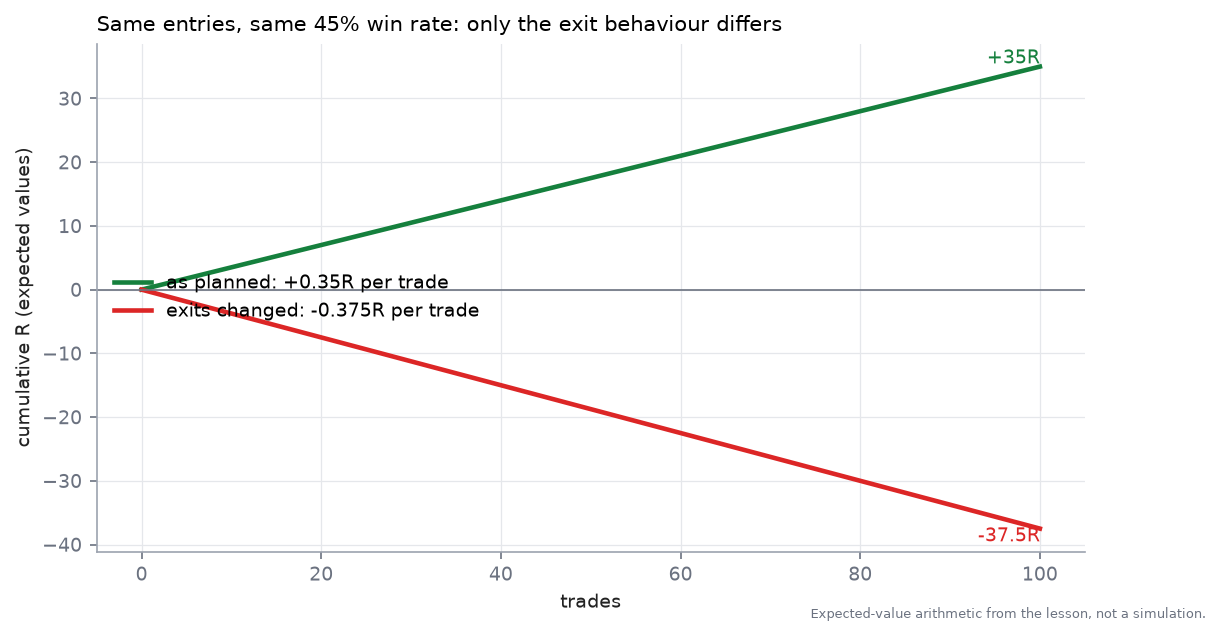
What to notice: That only the exit behaviour differs.
Example 2: the cost of too many trades
A rule limits the trader to 3 trades a day. Without it, boredom or excitement leads to 8. Assume, for illustration only, that the average cost per trade (spread plus commission) is 0.1R, and the extra trades have zero expectancy before costs.
1. Over 20 trading days, 3 trades a day is 60 trades, costing 60 × 0.1 = 6R.
2. 8 trades a day is 160 trades, costing 16R.
3. The extra 100 trades add 10R of cost and, by assumption, nothing else.
The 0.1R is an assumption chosen to make the arithmetic clear. Your costs depend on your instrument, stop size and broker, so measure them in your journal. The point is that trades with no edge are not free.
Example 3: writing a rule set
A short rule set for a beginner could read:
1. Trade only the setup in my plan, on my chosen instrument and timeframe.
2. Risk at most 0.5% of the account on a trade.
3. Never more than three trades a day and never more than 1.5% of the account at risk at once.
4. Place the stop before entering and never move it further from the entry.
5. Stop trading for the day after a loss of 1% (two full losses) or after two rule breaks.
6. Write the journal entry before the trade and after it.
7. Review the week every Sunday and change at most one rule at a time.
Each line can be checked with a yes or no. That is the test of a good rule.
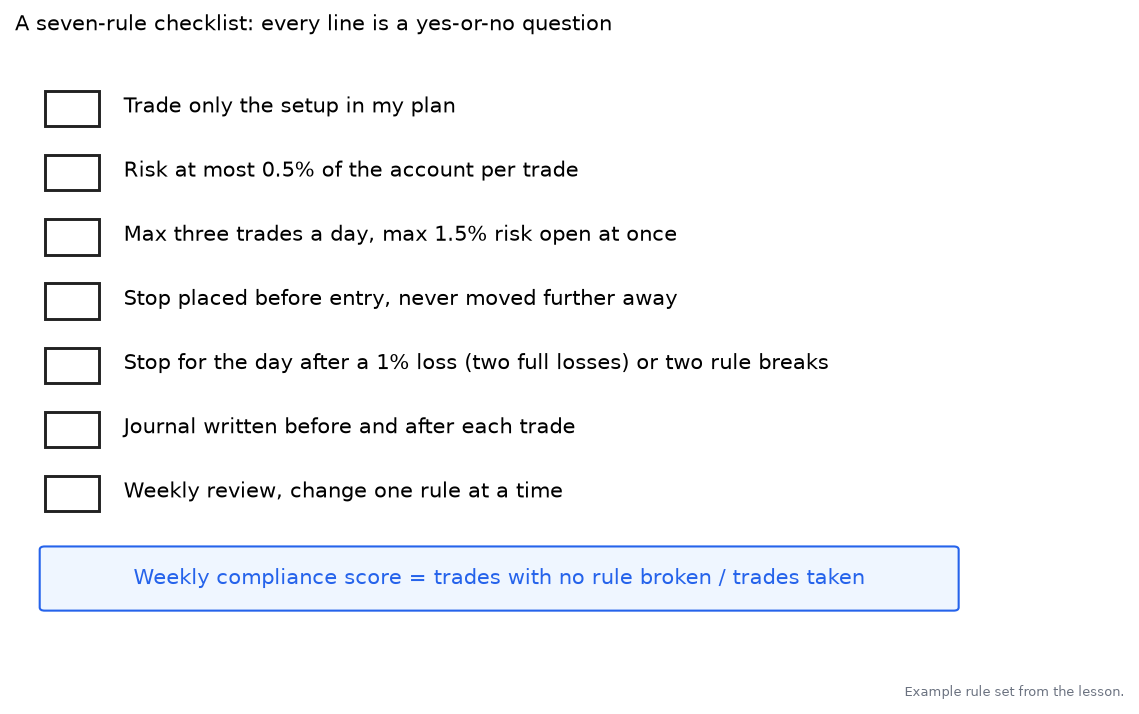
What to notice: That each rule is a yes or no question.
How to apply it step by step
- Write down the three or four mistakes that cost you most, from your journal if you have one.
- For each, write an if-then rule that prevents it.
- Add the risk rules: risk per trade, maximum daily loss, maximum trades per day, maximum open risk.
- Print the rules or keep them in front of you while you trade.
- After each trade, mark whether every rule was followed.
- At the end of the week, compute compliance: the share of trades with no rule break.
- Compare the results of compliant trades with the rest, once you have enough trades.
- Change a rule only in writing, only after the week ends and only one at a time.
- If you break a rule, write down what led to it (state, time, previous result) and add a rule for that situation.
Common mistakes
- Vague rules. “Be patient” cannot be checked.
- Too many rules. If you cannot remember them, you cannot follow them. Start with five to seven.
- Rules without numbers. Risk limits need figures.
- Changing rules during the day. Changes belong in the weekly review.
- Blaming the method for rule breaks. Test the method with the rules followed.
- Treating a winning rule break as proof. A winner after breaking a rule is outcome bias; it teaches the wrong lesson.
- Punishing yourself. The aim is to find the situation that causes the break, not to feel bad.
When it works and when it does not
Rules work best against the mistakes you can name in advance: oversizing, moving stops, overtrading, trading outside your plan. The research on implementation intentions supports the idea that if-then plans help people act on goals, with a medium-to-large average effect in its meta-analysis.
Rules do not make a poor method profitable, and a rule that is never followed is worth nothing. The studies we cite are about investors and about general goal pursuit, so we cannot tell you from them how much a rule set would improve your trading. If you cannot follow a rule because it does not suit you, change it deliberately in the weekly review rather than ignoring it quietly. And accept that no set of rules removes the need for judgment when something unexpected happens, such as a platform outage or a sudden news shock; write a rule for that too, such as “close the position and review”.
Practice exercise
A method has a 40% win rate, winners at +2.5R and losers at −1R.
- What is the expectancy as planned?
- The trader starts closing winners early at +1.5R and the win rate does not change. What is the new expectancy?
- By how much has each trade’s expectancy changed, and over 100 trades?
- Write an if-then rule that would prevent this change.
Answers:
1. 0.40 × 2.5 − 0.60 × 1 = 1.0 − 0.6 = +0.40R.
2. 0.40 × 1.5 − 0.60 × 1 = 0.6 − 0.6 = 0.0R.
3. 0.40R per trade, or 40R over 100 trades.
4. For example: “If a trade is open and has not reached its stop or target, then I do not touch it, except as my written plan allows.” Any rule that is specific and checkable is fine.
Key terms
Discipline – acting on a plan made in advance when pressure pushes you to do something else.
Rule – a specific, checkable instruction made in advance.
Implementation intention – a plan of the form “if situation X, then I will do Y”.
Overtrading – taking more trades than the plan calls for.
Disposition effect – the tendency to sell winners too early and hold losers too long.
Compliance – the share of trades that followed every rule.
Expectancy – average result per trade, in R.
Checklist – a short list of conditions to confirm before acting.
Frequently asked questions
What is trading discipline?
Following the rules of your plan when emotion or boredom pushes you to do otherwise. It is easier when rules are specific, written in advance and checked after each trade.
What are implementation intentions?
If-then plans such as “If price hits my stop, then I let it close”. A meta-analysis of 94 tests found a medium-to-large positive effect (d = 0.65) on goal attainment, though not in trading.
How many trading rules should I have?
Start with five to seven that you can remember and check. Add a rule when your journal shows a repeated mistake that none of the existing rules covers.
What happens if I break a rule and win?
You have a bad habit that was rewarded. Record it as a rule break anyway, because judging by outcome teaches the wrong lesson and makes the next break more likely.
Why limit the number of trades per day?
Costs add up and overtrading was linked to poorer results. In Barber and Odean’s study of 66,465 households, those who traded most earned 11.4% a year while the market returned 17.9%.
Can discipline be learned?
Written rules, a journal and a weekly review give you a structure that makes it easier. There is no guarantee, and some days will still go wrong, which is why the risk rules come first.
Key takeaways
- Discipline means following rules that were made in advance.
- Good rules are specific, checkable and written in if-then form.
- Risk rules matter most, because they limit the damage of other failures.
- Breaking exit rules can turn a profitable method into a losing one, even with the same entries.
- Review rules weekly and change one at a time.
Quick quiz
Q1. What are the three properties of a good trading rule?
A: It is specific, checkable and made in advance.
Q2. Rewrite “avoid big losses” as a checkable rule.
A: For example, “I risk at most 0.5% of the account per trade and stop for the day after a 1% loss”.
Q3. A method wins 50% of the time with +2R winners and −1R losers. What is the expectancy?
A: 0.5 × 2 − 0.5 × 1 = +0.5R per trade.
Q4. Closing the winners at +1R instead of +2R in the previous question gives what expectancy?
A: 0.5 × 1 − 0.5 × 1 = 0R.
Q5. What did Barber and Odean find about the most active traders?
A: They earned an annual return of 11.4% against 17.9% for the market in their sample of 66,465 households.
Q6. Why note a rule break that won?
A: Otherwise outcome bias will reward the behaviour and make it more likely.
Going deeper
- Your first trading plan – the plan that your rules protect.
- Keeping a trading journal – how to measure compliance.
- Risk, reward and expectancy – the arithmetic used above.
- Prop firm rules and risk – an example of externally imposed rules.
- Trading journal tool – log the setup, the session and any rule you broke.
- Overtrading: what extra trades cost – a trade cap and a stop-for-the-day rule, with the cost arithmetic.